Recap of the Opening Keynote by Bertrand Meyer at Swiss Testing Day 2026
(DE Version below)
“Just state what you need” – in that “just” lies the entire discipline of requirements engineering.
Bertrand Meyer – Programmer, Entrepreneur, Author, Language Designer, Researcher, and Software Legal Expert – founder of Eiffel Software and Recognyze AI, opened Swiss Testing Day 2026 with a 55-minute keynote that navigated between AI euphoria and sober analysis – and ended surprisingly optimistic.
Key Takeaways
- AI support for software engineering is here to stay, but coding is only 10–20% of the effort
- Two kinds of technology breakthroughs: Type L (Leveling) vs. Type E (Enhancing) – AI is both, depending on the software category
- Hallucinations are structural, not accidental – they won’t disappear with better models
- The future lies in AI agents for requirements, architecture, testing, proofs, and deployment – with the human at the center
- Quality and verification are becoming more important, not less
The Anxiety – and Why It’s Justified
Meyer went straight in: “We are entering an era where people in the profession are worried. Maybe doom and gloom is a little bit too much, but certainly there’s a lot of anxiety in the field.” His goal: not to reassure, but to sort the facts – with what he humorously called “B.A.D.”: Bullshit-Avoidance Discipline.
His rules: only evaluate the latest, professional tool versions. Use measured evidence, not anecdotes. Distinguish early hiccups from long-term properties. And: account for publication bias – typically only spectacular successes and spectacular catastrophes get published.
Vibe Coding and the History of “We Don’t Need Programmers Anymore”
Andrej Karpathy’s viral tweet about “vibe coding” is only a year old, but already everyday reality: 30% of Microsoft code is written by AI (Nadella), 25% at Google, and 25% of Y Combinator startups have AI generate 95% of their code.
Meyer put this in historical context: we’ve been hearing the same claim since the 1960s. COBOL, 4GL, Japanese 5th generation, OOP, Model-Driven Architecture, low-code – each time, programmers were supposed to become obsolete. Each time, abstraction improved, but programming remained. So is AI just another step up – or a true paradigm shift?
The ABC of Software Development
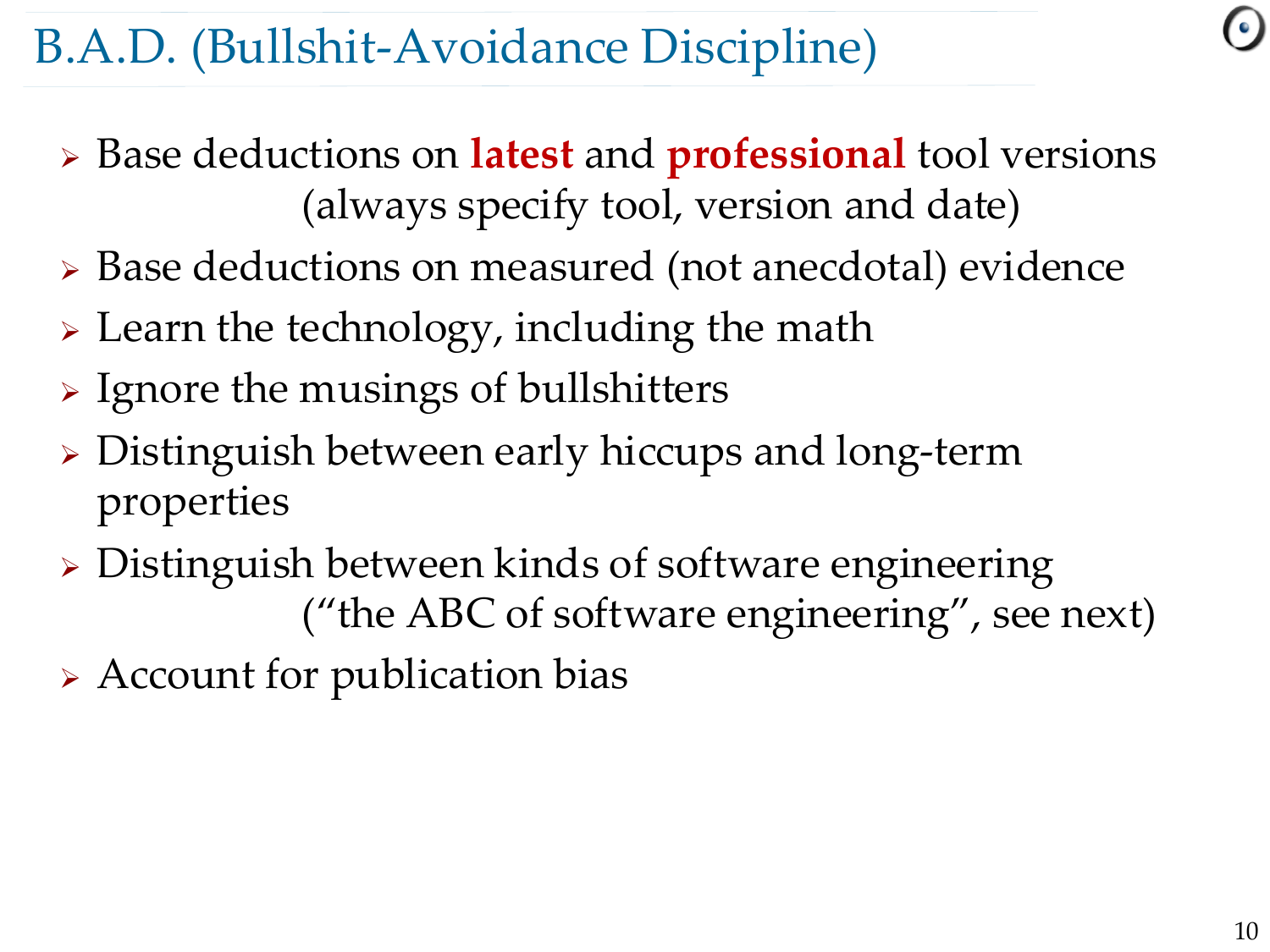
Meyer’s “B.A.D.” (Bullshit-Avoidance Discipline): Rules for sober AI assessment
Meyer’s key distinction: not all software is equal.
- C (Casual): MVPs, demos, prototypes – AI is already a game changer here. “The times at which you had to hire a programmer to write a demo program – this is over.”
- A (Acute/Mission-Critical): If it doesn’t work, someone dies. Aerospace, medical devices, defense.
- B (Business): Banking, insurance, industry – must work, even if nobody dies.
For C-class, AI is Type L (Leveling): everyone is suddenly equally capable. For A and B, AI is Type E (Enhancing): the best get even better, the gap to beginners grows.
“Just State What You Need”: The Requirements Problem
Coding accounts for only 10–20% of software engineering. Requirements engineering, architecture, design, verification, maintenance – all of that remains. And if requirements are stated wrong, AI will code the wrong thing.
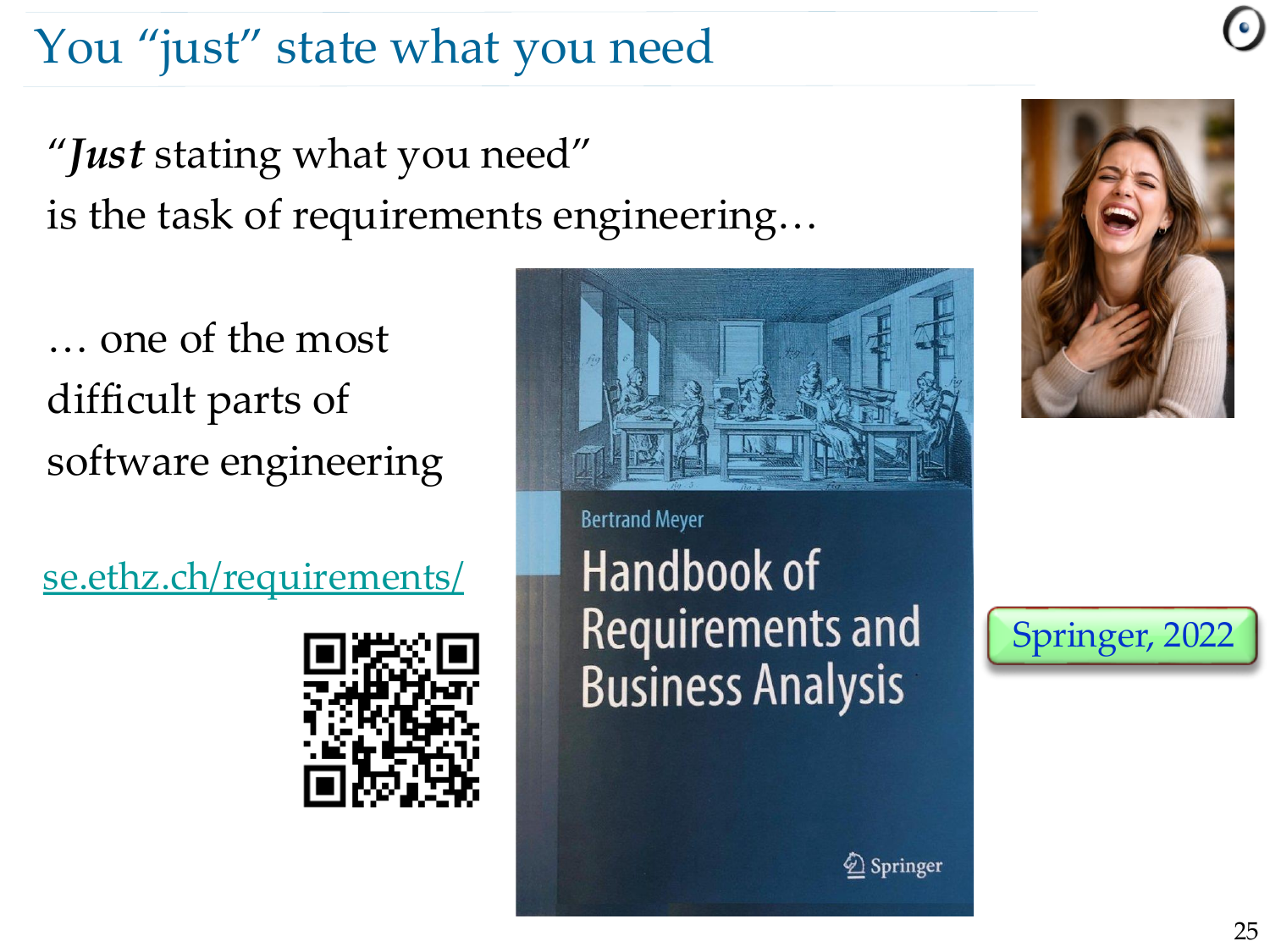
Meyer’s reaction to “just state what you need”: that “just” contains one of the hardest problems in software engineering
Meyer emphasized: “‘Just stating what you need’ is the task of requirements engineering — one of the most difficult parts of software engineering.” It’s a different kind of difficulty – no algorithms and data structures, but the same precision, abstraction, and structuring effort.
Hallucinations Are Structural
The horror stories are real: AI platforms deleting production databases. Meyer’s team systematically studied the phenomenon and identified the “hallucination loop”: the AI takes a wrong direction, insists on it, makes small fixes instead of restarting – and eventually the user gives up, novice or expert alike.
Critically: “The hallucination phenomenon is not something accidental. It is in the guts of the technology.” Newer models hallucinate less, but the problem will never fully disappear because it’s inherent to the statistical nature of the technology.
The Future: AI Agents with the Human at the Center
Meyer’s vision for the development process with AI: the human remains at the center, surrounded by specialized agents:
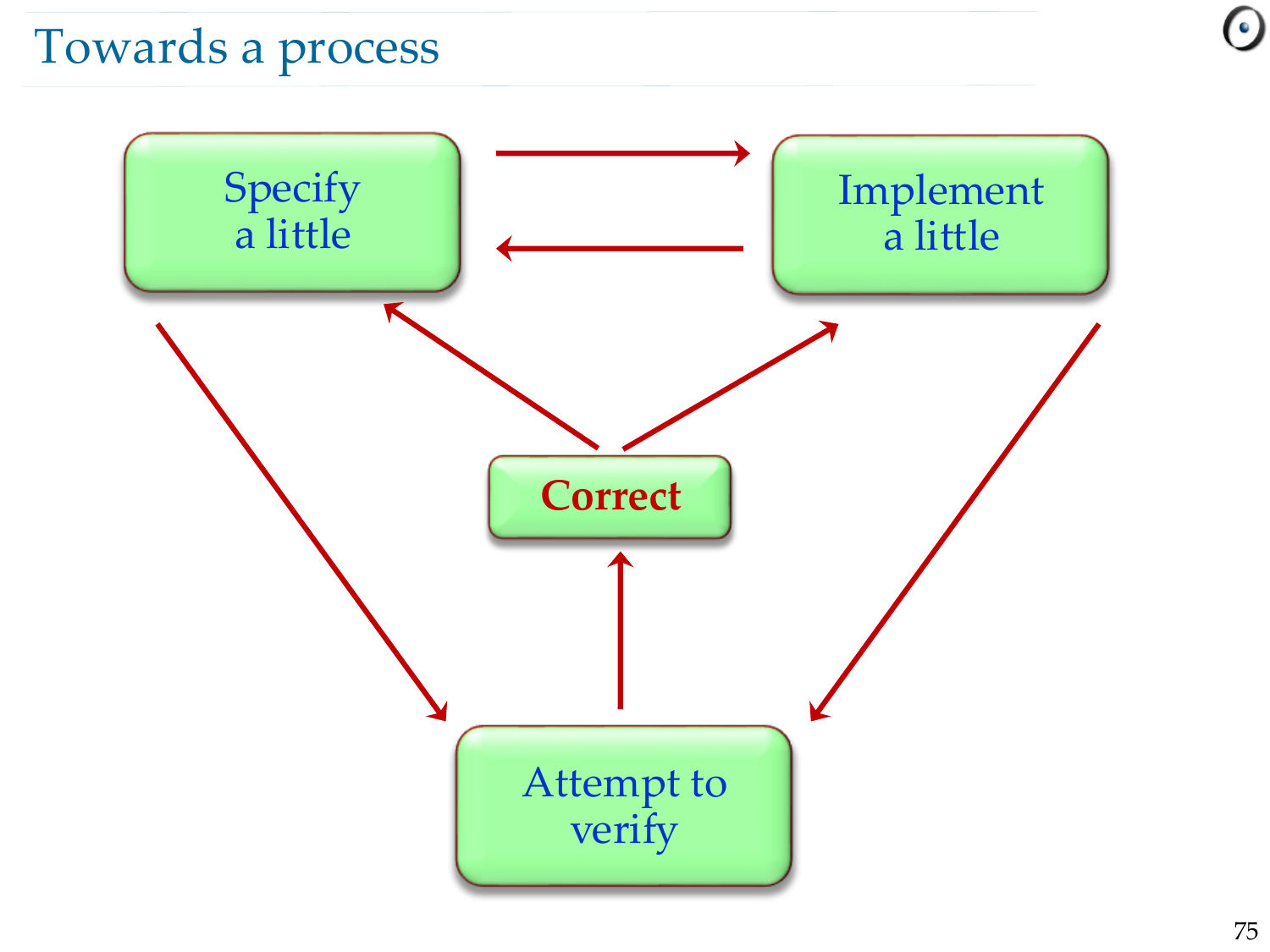
Meyer’s realistic process: Specify, Implement, Verify, Correct – iterative, not linear
- Requirements Agent: formulate requirements
- Architecture Agent: design architecture
- Contracting Agent: seed programs with contracts (pre/postconditions, invariants)
- Coding Agent: the obvious one, but only part of the picture
- Test Generation Agent: the truly hard part: generating tests, not just running them
- Proving Agent: mathematical verification
- Deployment Agent: DevOps integration
“We can achieve orders of magnitude improvement by well-coordinated agents. This is a research program for the next ten years.”
What This Means for Your Career
Meyer closed with concrete career advice:
The “barbell hiring” danger: Companies hire only very senior developers and fresh graduates, with nothing in between. This is dangerous.
More competence, not less: “If you do not understand the generated code, you are completely lost at the first sign of a problem.” The MIT experiment showed it clearly: students who coded fastest with ChatGPT couldn’t explain or extend the code weeks later. The “old-fashioned” group could do both.
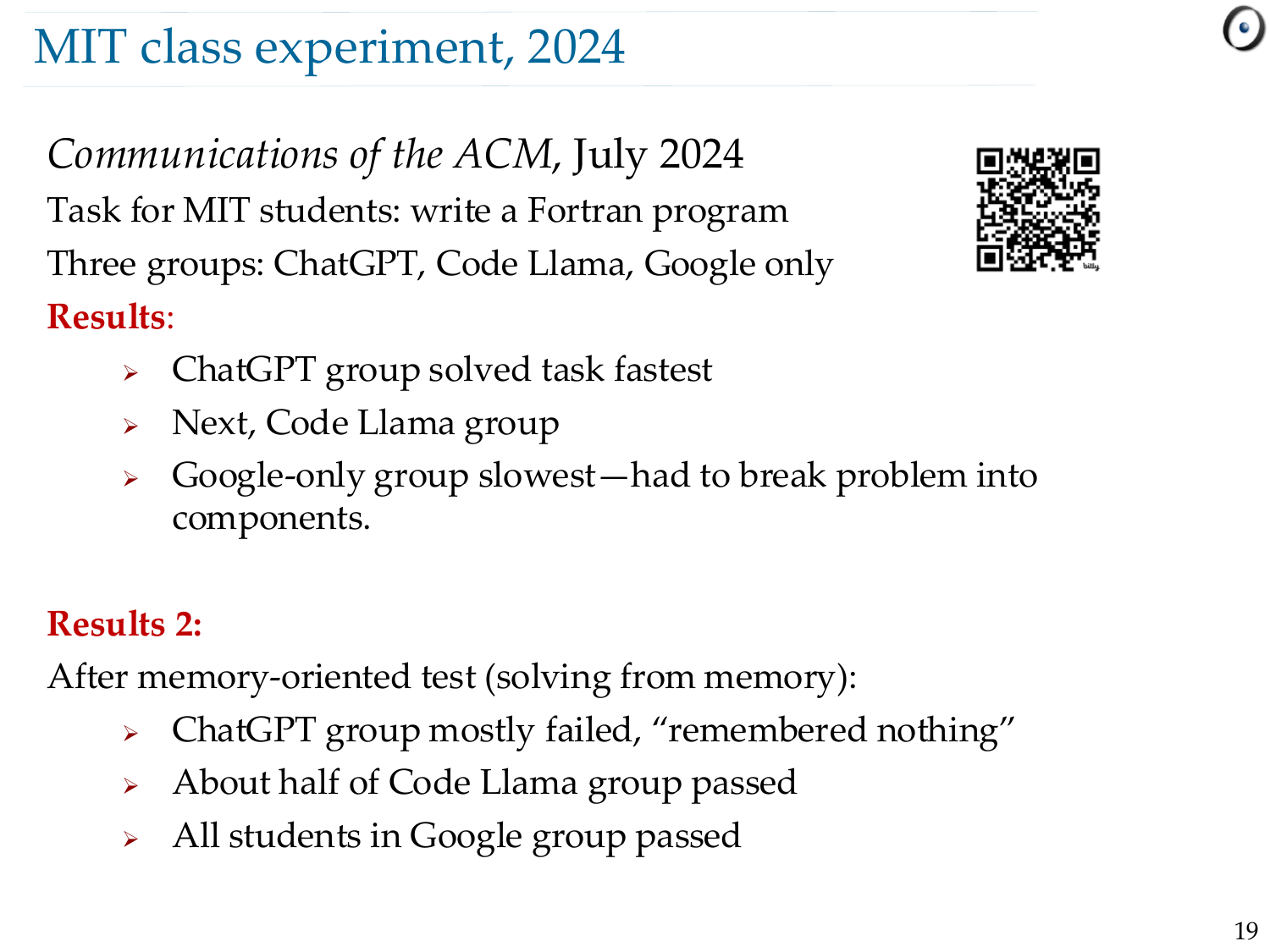
The MIT experiment 2024: Faster coding with AI – but without understanding your own code
Insourcing over outsourcing: Prospects for low-skill outsourcing are bleak. Companies can reclaim their expertise. Good news for skilled professionals in Europe.
Quality remains king: All lessons of software engineering still apply – more than ever.
About the Speaker
Bertrand Meyer – Programmer, Entrepreneur, Author, Language Designer, Researcher, Software Legal Expert – is the founder of Eiffel Software and Recognyze AI. Former head of the Computer Science department at ETH Zurich and author of numerous standard works, including “Object-Oriented Software Construction” and “Handbook of Requirements and Business Analysis.”
Software Verification in the Age of AI: Warum Entwickler mehr Kompetenz brauchen, nicht weniger
“Just state what you need”: in diesem “just” steckt das gesamte Requirements Engineering. Bertrand Meyer, Programmer, Entrepreneur, Author, Language Designer, Researcher und Software Legal Expert, Gründer von Eiffel Software und Recognyze AI, eröffnete den Swiss Testing Day 2026 mit einer 55-minütigen Keynote, die zwischen KI-Euphorie und nüchterner Analyse navigierte und überraschend optimistisch endete.
Key Takeaways
- KI-Unterstützung für Software Engineering ist gekommen, um zu bleiben, aber Coding ist nur 10–20 % des Aufwands
- Zwei Arten von Technologie-Durchbrüchen: Type L (Leveling) vs. Type E (Enhancing): KI ist beides, je nach Software-Kategorie
- Halluzinationen sind strukturell, nicht zufällig: sie verschwinden nicht mit besseren Modellen
- Die Zukunft liegt in KI-Agenten für Requirements, Architektur, Testing, Proofs und Deployment, mit dem Menschen im Zentrum
- Qualität und Verifikation werden wichtiger, nicht weniger wichtig
Die Angst: und warum sie berechtigt ist
Meyer stieg direkt ein: “We are entering an era where people in the profession are worried. Maybe doom and gloom is a little bit too much, but certainly there’s a lot of anxiety in the field.” Sein Ziel: nicht beschwichtigen, sondern die Fakten ordnen, und zwar mit dem, was er humorvoll “B.A.D.” nannte: Bullshit-Avoidance Discipline.
Seine Regeln: Nur die neuesten, professionellen Tool-Versionen bewerten. Gemessene Evidenz statt Anekdoten. Frühe Kinderkrankheiten von langfristigen Eigenschaften unterscheiden. Und: Publication Bias beachten, denn publiziert werden typischerweise nur die spektakulären Erfolge und die spektakulären Katastrophen.
Vibe Coding und die Geschichte von “Wir brauchen keine Programmierer mehr”
Andrej Karpathys viraler Tweet über “Vibe Coding” ist erst ein Jahr alt, aber bereits Alltag: 30 % des Microsoft-Codes schreibt KI (Nadella), 25 % bei Google, und 25 % der Y-Combinator-Startups lassen 95 % ihres Codes generieren.
Meyer ordnete das historisch ein: Dieselbe Behauptung hören wir seit den 1960ern. COBOL, 4GL, japanische 5. Generation, OOP, Model-Driven Architecture, Low-Code: jedes Mal sollten Programmierer überflüssig werden. Jedes Mal verbesserte sich die Abstraktion, aber die Programmierung blieb. Ist KI also nur eine weitere Stufe oder ein echter Paradigmenwechsel?
Das ABC der Software-Entwicklung
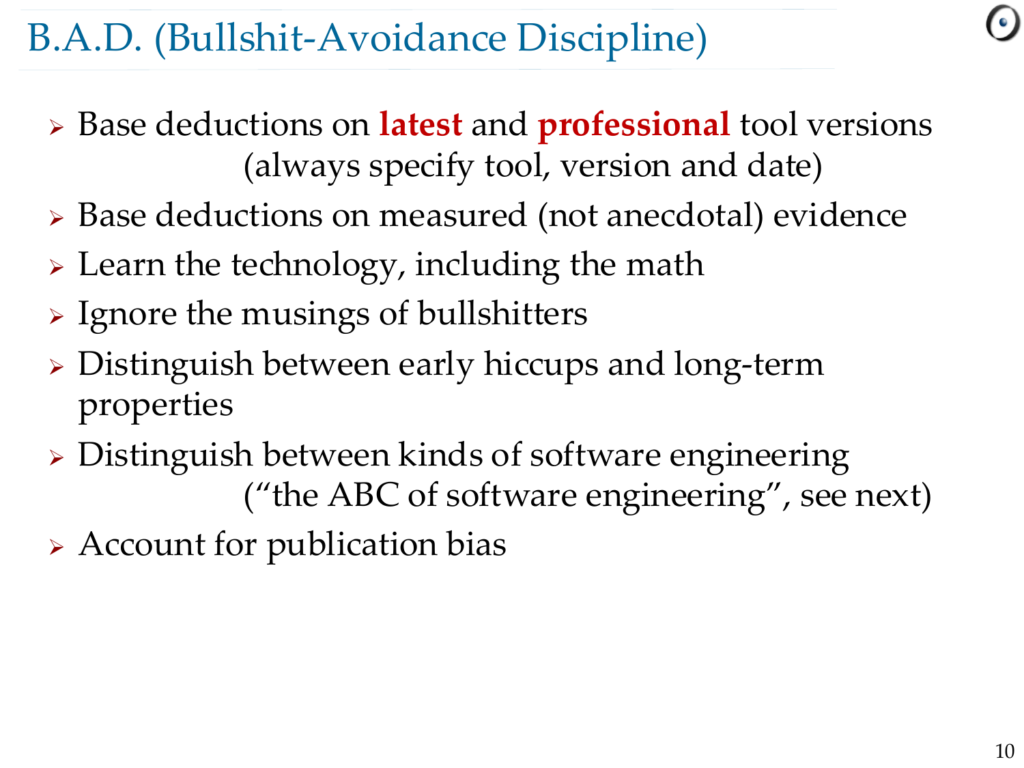
Meyers “B.A.D.” (Bullshit-Avoidance Discipline): Die Regeln für eine nüchterne Bewertung von KI
Meyers Schlüsselunterscheidung: Nicht alle Software ist gleich.
- C (Casual): MVPs, Demos, Prototypen: hier ist KI bereits ein Game Changer. “The times at which you had to hire a programmer to write a demo program — this is over.”
- A (Acute/Mission-Critical): Wenn es nicht funktioniert, stirbt jemand. Luft- und Raumfahrt, Medizintechnik, Verteidigung.
- B (Business): Banking, Versicherungen, Industrie: muss funktionieren, auch wenn niemand stirbt.
Für C-Klasse ist KI Type L (Leveling): Alle sind plötzlich gleich gut. Für A und B ist KI Type E (Enhancing): Die Besten werden noch besser, der Abstand zu den Anfängern wächst.
“Just state what you need”: Das Requirements-Problem
Coding macht nur 10–20 % des Software-Engineering aus. Requirements Engineering, Architektur, Design, Verifikation, Wartung: all das bleibt. Und wenn die Anforderungen falsch formuliert sind, codiert die KI das Falsche.
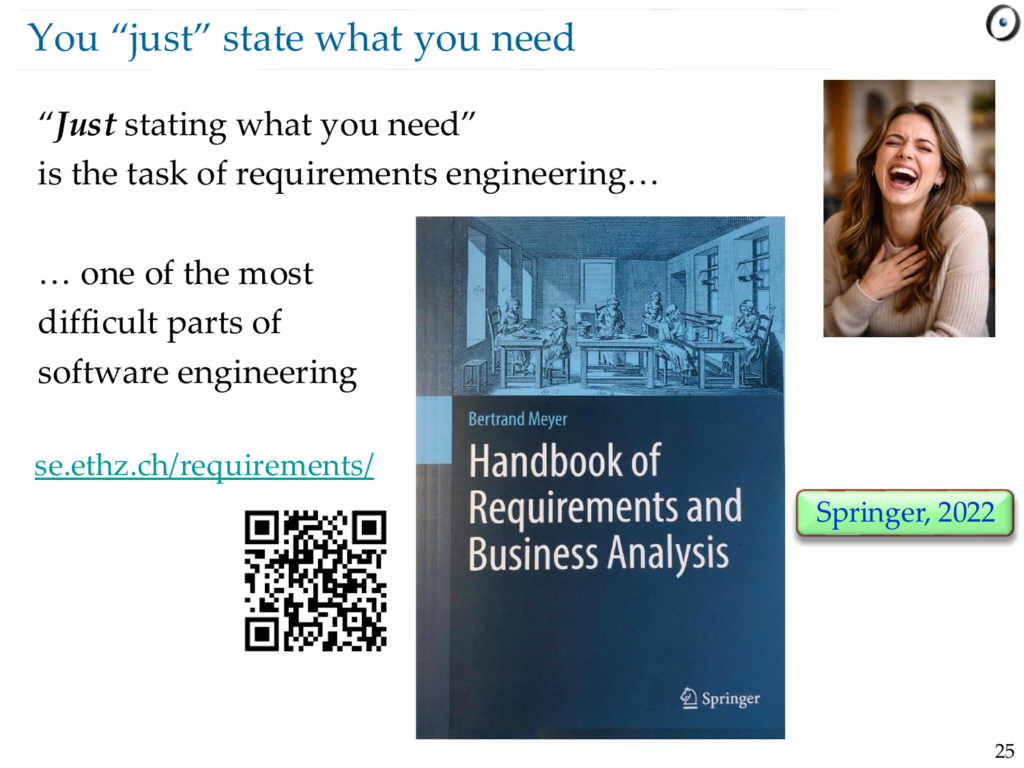
Meyers Reaktion auf “just state what you need”: In diesem “just” steckt eines der schwierigsten Probleme des Software Engineering
Meyer betonte: “‘Just stating what you need’ is the task of requirements engineering — one of the most difficult parts of software engineering.” Es ist eine andere Art von Schwierigkeit: keine Algorithmen und Datenstrukturen, aber dieselbe Präzision, Abstraktion und Strukturierung.
Halluzinationen sind strukturell
Die Horror-Geschichten sind real: KI-Plattformen, die Produktionsdatenbanken löschen. Meyers Team untersuchte das Phänomen systematisch und identifizierte den “Hallucination Loop”: Die KI schlägt eine falsche Richtung ein, beharrt darauf, macht kleine Korrekturen statt einen Neustart, und am Ende gibt der Nutzer auf, egal ob Anfänger oder Experte.
Entscheidend: “The hallucination phenomenon is not something accidental. It is in the guts of the technology.” Neuere Modelle halluzinieren weniger, aber das Problem wird nie vollständig verschwinden, weil es in der statistischen Natur der Technologie liegt.
Die Zukunft: KI-Agenten mit dem Menschen im Zentrum
Meyers Vision für den Entwicklungsprozess mit KI: Der Mensch bleibt im Zentrum, umgeben von spezialisierten Agenten:
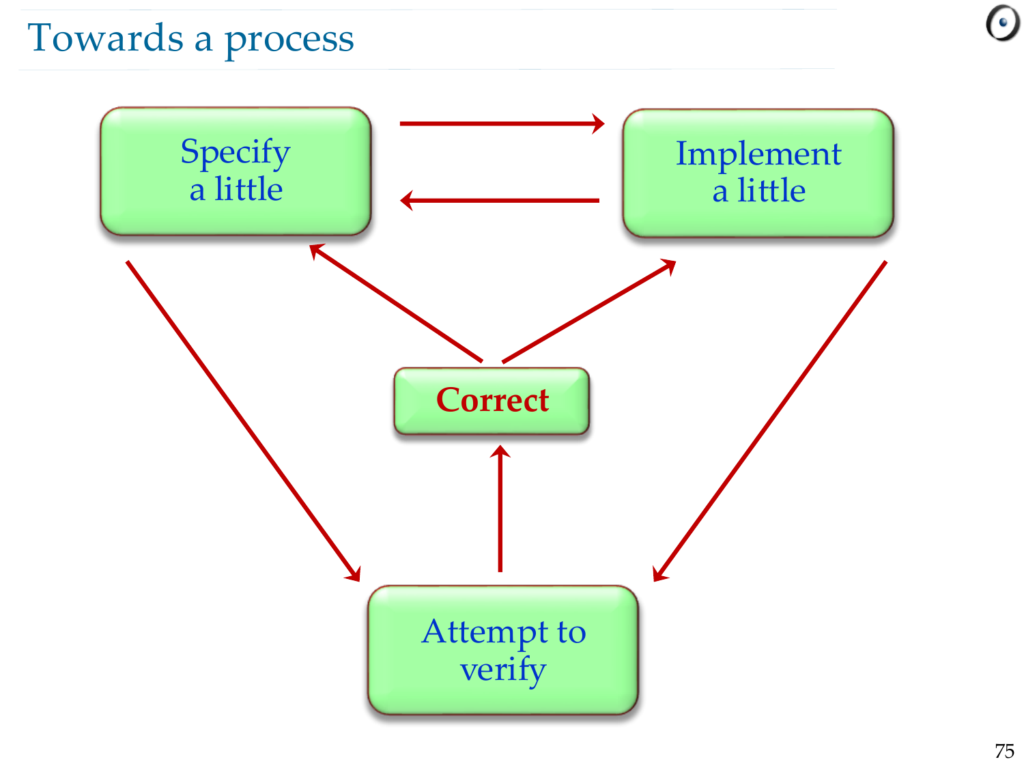
Meyers realistischer Prozess: Spezifizieren, Implementieren, Verifizieren, Korrigieren: iterativ, nicht linear
- Requirements Agent: Anforderungen formulieren
- Architecture Agent: Architektur entwerfen
- Contracting Agent: Contracts (Pre-/Postconditions, Invarianten) setzen
- Coding Agent: der offensichtlichste, aber nur ein Teil
- Test Generation Agent: das wirklich Schwierige: Tests generieren, nicht nur ausführen
- Proving Agent: mathematische Verifikation
- Deployment Agent: DevOps-Integration
“We can achieve orders of magnitude improvement by well-coordinated agents. This is a research program for the next ten years.”
Was bedeutet das für Ihre Karriere?
Meyer schloss mit konkreten Karriere-Empfehlungen:
Die Gefahr des “Barbell Hiring”: Unternehmen stellen nur noch sehr Senior-Entwickler und Berufseinsteiger ein, nichts dazwischen. Das ist gefährlich.
Mehr Kompetenz, nicht weniger: “If you do not understand the generated code, you are completely lost at the first sign of a problem.” Das MIT-Experiment zeigte es klar: Studierende, die mit ChatGPT am schnellsten codierten, konnten Wochen später den Code weder erklären noch erweitern. Die “altmodische” Gruppe konnte beides.
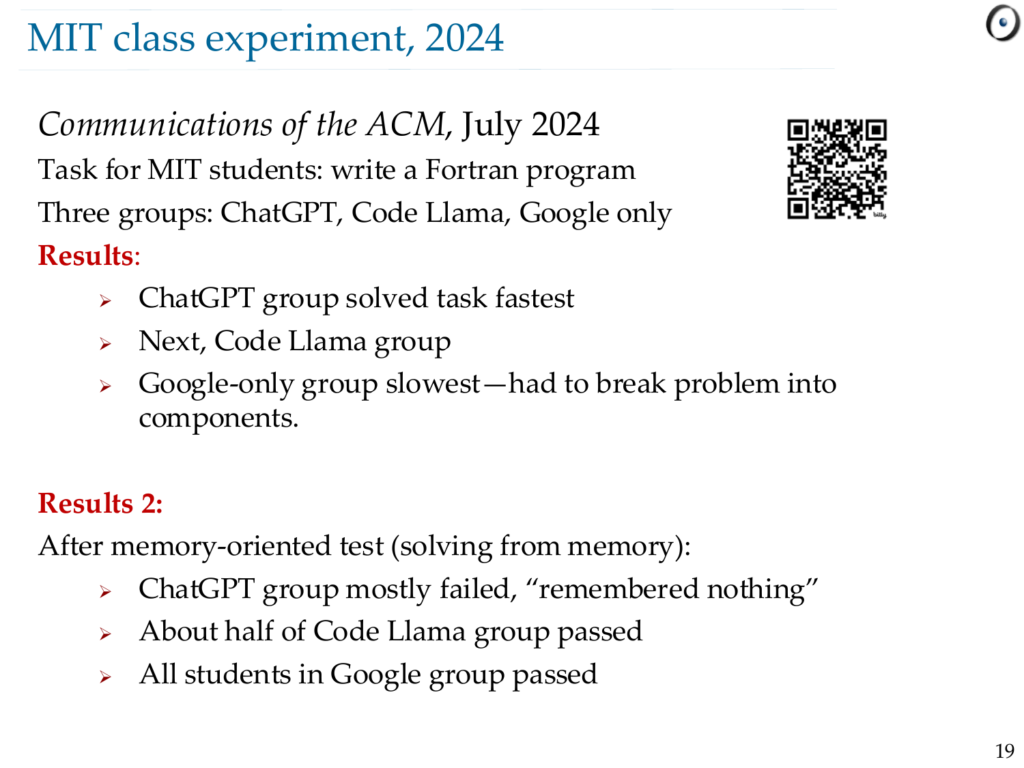
Das MIT-Experiment 2024: Schneller coden mit KI, aber ohne Verständnis des eigenen Codes
Insourcing statt Outsourcing: Die Aussichten für Low-Skill-Outsourcing sind trüb. Unternehmen können ihr Wissen zurückholen. Gute Nachricht für Fachkräfte in Europa.
Qualität bleibt König: Alle Lektionen des Software Engineering gelten weiterhin, mehr denn je.
Über den Speaker
Bertrand Meyer, Programmer, Entrepreneur, Author, Language Designer, Researcher, Software Legal Expert, ist Gründer von Eiffel Software und Recognyze AI. Ehemaliger Leiter des Fachbereichs Informatik an der ETH Zürich und Autor zahlreicher Standardwerke, darunter “Object-Oriented Software Construction” und “Handbook of Requirements and Business Analysis”.
Based on the Opening Keynote “Software Verification in the Age of Artificial Intelligence” by Bertrand Meyer at Swiss Testing Day 2026 in Zurich (Main Stage, 08:50–09:45). Conference theme: “Defining Quality in a Dangerous Decade”.
Swiss Testing Day: the leading conference for software quality in Switzerland.