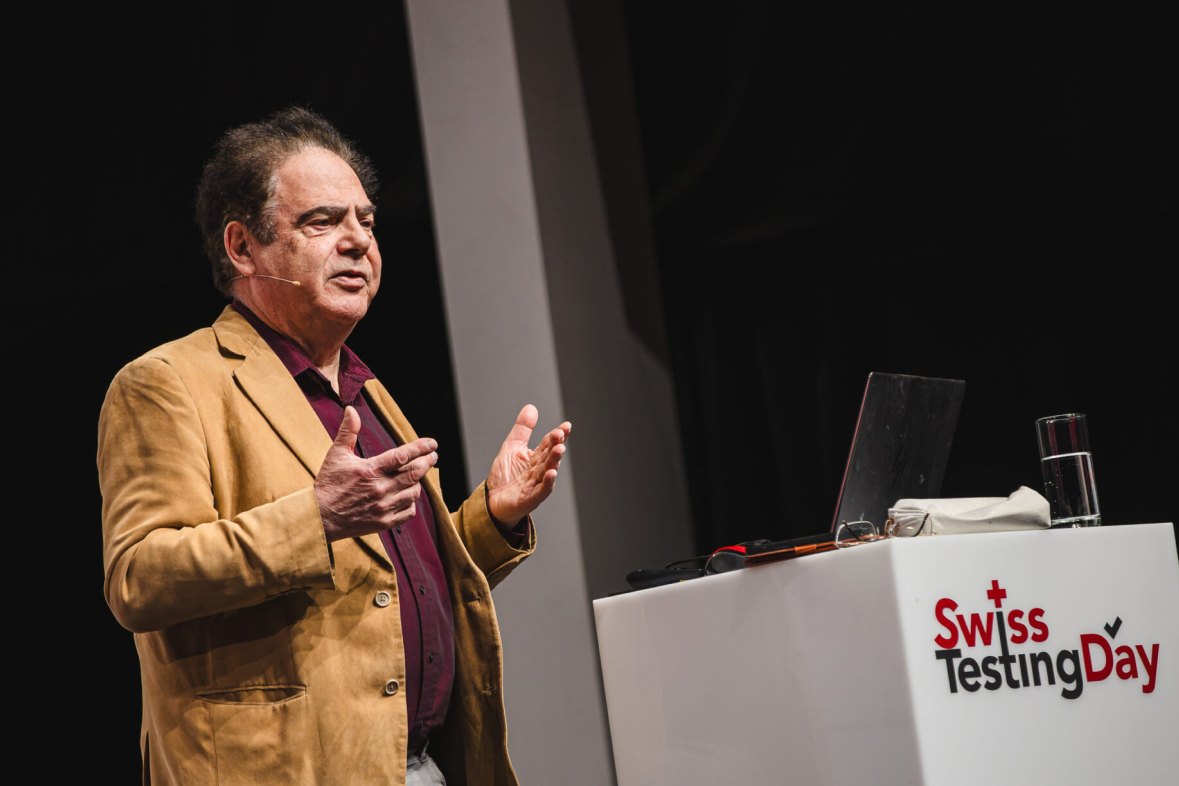
Recap of the talk by Fabian Deuber and Piersandro Cancellara at Swiss Testing Day 2026
(German Version Below)
Imagine: perfect flight, on-time landing, but your luggage is lost. Would you fly that airline again? Fabian Deuber and Piersandro Cancellara from Roche Diagnostics showed at Swiss Testing Day 2026 why technical safety alone is no longer sufficient, and how their “Customer Zero” concept tests the end-to-end experience before products reach the customer.
Key Takeaways
- “Landing safe isn’t enough”: safety is mandatory in medical devices, but no longer a differentiator
- Roche introduced two new process stages: Immersive Stage (flight simulator) and Customer Zero (test flight)
- Good QA starts with good requirements: not with tools. “If the foundation is not there, you can throw tools at it to no avail.”
- The QA process itself becomes a value proposition for customers
- Development cycles of 5–8 years demand early validation at solution level, not just product level
What Do Aviation and Diagnostics Have in Common?
“There is no such thing as a harmless mistake.” That’s how Piersandro Cancellara opened the session. Whether you’re flying at 30,000 feet or delivering urgent lab results: mistakes are not an option. Aviation understood this decades ago and made human factors engineering part of its DNA. Roche Diagnostics did the same.
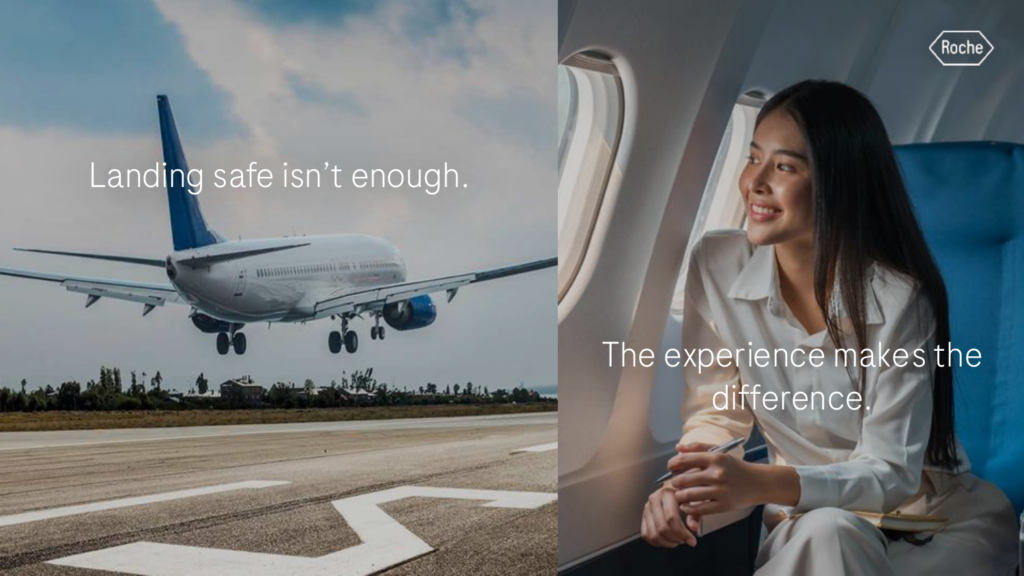
Roche’s core message: landing safely isn’t enough. The overall experience makes the difference
But in today’s world, safety is no longer a differentiator. The lost luggage after a perfect flight ruins the experience, no matter how good the in-flight service was. The same applies in diagnostics: if the customer installation fails, the best technology is worthless.
From Product Requirements to Solution Requirements
Roche Diagnostics (not big pharma, but roughly 30% of the Roche Group) builds instruments ranging from wardrobe-sized systems (with robotics and automation) to handheld devices and pure software solutions. In Cancellara’s words: “Precise as Rolex, with the technology of a space rocket.”
The team realized: they excelled at product requirements and launch preparation. But they weren’t thinking enough about the solution level: how all products interact within the ecosystem. And they celebrated launch, not successful customer installation. Two critical gaps.
The 5-Step Process: From Sketch to Customer Zero
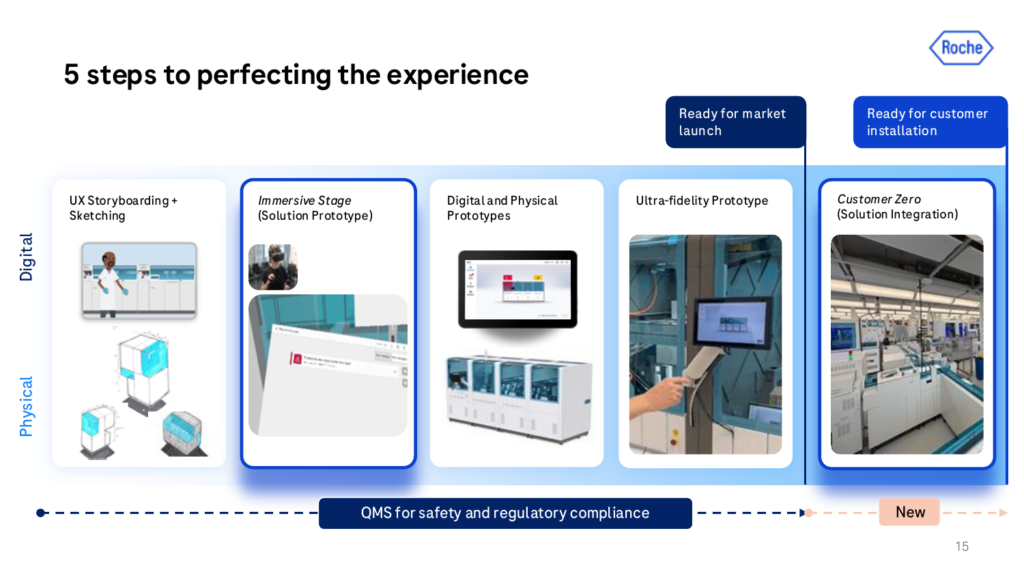
Roche’s expanded process: Two new stages (Immersive Stage + Customer Zero) bridge the gap between product development and customer experience
Roche introduced two new stages into their development process:
Immersive Stage, the Flight Simulator: A digitized environment simulating the entire customer experience. Real workflows, life-size spatial experiences, mixed reality. The team can switch from an emergency room to a large laboratory in minutes. Started with VR, then moved to wall projection: cheaper, faster, more scalable. The game changer: you can walk through a solution at the scale of the real experience and validate requirements early on.
Customer Zero, the Test Flight: Real, functioning labs operated internally by R&D, global customer support, and business. With 5–8 year development cycles, the people who did requirements elicitation may be gone when the product is finished. Customer Zero brings everything together (products, software, third-party components) in a controlled environment where things are allowed to break.
“It shouldn’t be perfect. It should get us to a place where we’re confident to launch.”
What This Means for Your Team
Three takeaways that extend beyond medical devices:
1. QA as value proposition. Customers want to see how things fail and how you fix them. The testing process itself builds trust.
2. Process before tools. If requirements are wrong, no AI tool will help. Fix the process first, then optimize.
3. Think in solutions, not products. Individual components can be perfect: the customer experience emerges from how they interact.
About the Speakers
Fabian Deuber is Global Head of Solution Management at Roche Diagnostics. His team bridges R&D and business: from detail level to high-level understanding.
Piersandro Cancellara is Global Head of Digital Design & Experience Testing at Roche Diagnostics, responsible for conceiving and validating the digital and physical customer experience.
Customer Zero: Warum sicher Landen nicht mehr reicht, Roche Diagnostics über End-to-End-Qualität
Rückblick auf den Vortrag von Fabian Deuber und Piersandro Cancellara am Swiss Testing Day 2026
Stellen Sie sich vor: perfekter Flug, pünktliche Landung, aber der Koffer ist weg. Würden Sie wieder mit dieser Airline fliegen? Fabian Deuber und Piersandro Cancellara von Roche Diagnostics zeigten am Swiss Testing Day 2026, warum technische Sicherheit allein nicht mehr genügt und wie sie mit dem “Customer Zero”-Konzept die End-to-End-Erfahrung testen, bevor Produkte beim Kunden landen.
Key Takeaways
- “Landing safe isn’t enough”: Sicherheit ist in der Medizintechnik Pflicht, aber kein Differenzierungsmerkmal mehr
- Roche hat zwei neue Prozessstufen eingeführt: Immersive Stage (Flugsimulator) und Customer Zero (Testflug)
- Gute QA beginnt bei guten Requirements: nicht bei Tools. “If the foundation is not there, you can throw tools at it to no avail.”
- Der QA-Prozess selbst wird zum Value Proposition gegenüber Kunden
- Entwicklungszyklen von 5–8 Jahren erfordern frühe Validierung auf Lösungsebene, nicht nur auf Produktebene
Was haben Luftfahrt und Diagnostik gemeinsam?
“There is no such thing as a harmless mistake.” So eröffnete Piersandro Cancellara die Session. Egal ob man in 10.000 Metern Höhe fliegt oder dringende Laborergebnisse liefert: Fehler sind keine Option. Das hat die Luftfahrt vor Jahrzehnten verstanden und Human Factors Engineering in ihre DNA integriert. Bei Roche Diagnostics ist es genauso.
Roches Kernbotschaft: Sicher landen reicht nicht. Die Gesamterfahrung macht den Unterschied
Aber: In der heutigen Welt ist Sicherheit kein Differenzierungsmerkmal mehr. Der verlorene Koffer nach dem perfekten Flug zerstört das Erlebnis, egal wie gut der Service an Bord war. Genauso in der Diagnostik: Wenn die Installation beim Kunden scheitert, nützt die beste Technologie nichts.
Von Produkt-Requirements zu Lösungs-Requirements
Roche Diagnostics (nicht Big Pharma, sondern rund 30 % der Roche-Gruppe) baut Instrumente von der Grösse eines Kleiderschranks (mit Robotik und Automatisierung) bis hin zu Handgeräten und reinen Software-Lösungen. In Cancelleras Worten: “Precise as Rolex, with the technology of a space rocket.”
Das Team erkannte: Sie waren gut bei Produkt-Requirements und Launch-Vorbereitung. Aber sie dachten nicht genug an die Lösungs-Ebene: wie alle Produkte im Ökosystem zusammenspielen. Und sie feierten den Launch, nicht die erfolgreiche Installation beim Kunden. Zwei kritische Lücken.
Der 5-Stufen-Prozess: Vom Sketch zum Customer Zero
Roches erweiterter Prozess: Zwei neue Stufen (Immersive Stage + Customer Zero) schliessen die Lücke zwischen Produktentwicklung und Kundenerlebnis
Roche führte zwei neue Stufen in ihren Entwicklungsprozess ein:
Immersive Stage, der Flugsimulator: Eine digitalisierte Umgebung, in der das gesamte Kundenerlebnis simuliert wird. Reale Workflows, lebensgrosse räumliche Erfahrungen, Mixed Reality. Das Team kann in Minuten von einer Notaufnahme zu einem Grosslabor wechseln. Begonnen mit VR, dann auf Wandprojektion umgestiegen: günstiger, schneller, besser skalierbar. Der Game Changer: Man kann durch eine Lösung im Massstab der realen Erfahrung laufen und Requirements frühzeitig validieren.
Customer Zero, der Testflug: Echte, funktionierende Labore, intern betrieben von R&D, Global Customer Support und Business. Bei Entwicklungszyklen von 5–8 Jahren sind die Leute, die Requirements erhoben haben, möglicherweise nicht mehr da, wenn das Produkt fertig ist. Customer Zero bringt alles zusammen (Produkte, Software, Drittanbieter-Komponenten) in einer kontrollierten Umgebung, in der Dinge brechen dürfen.
“It shouldn’t be perfect. It should get us to a place where we’re confident to launch.”
Was bedeutet das für Ihr Team?
Drei Takeaways, die über Medizintechnik hinaus gelten:
- Prozess vor Tools. Wenn die Requirements nicht stimmen, hilft kein KI-Tool. Erst den Prozess reparieren, dann optimieren.
- Denken Sie in Lösungen, nicht in Produkten. Einzelne Komponenten können perfekt sein: das Kundenerlebnis entsteht im Zusammenspiel.
- QA als Value Proposition. Kunden wollen sehen, wie Dinge scheitern und wie Sie sie reparieren. Der Testprozess selbst baut Vertrauen auf.
Über die Speaker
Fabian Deuber ist Global Head of Solution Management bei Roche Diagnostics. Sein Team schlägt die Brücke zwischen R&D und Business: von der Detail- bis zur Gesamtebene. Piersandro Cancellara ist Global Head of Digital Design & Experience Testing bei Roche Diagnostics, verantwortet die Konzeption und Validierung der digitalen und physischen Kundenerfahrung.
Based on the talk “Customer Zero – Perfecting the Experience Before It’s Airborne” at Swiss Testing Day 2026 in Zurich (Main Stage, 10:00–10:30). Conference theme: “Defining Quality in a Dangerous Decade”.
Swiss Testing Day: the leading conference for software quality in Switzerland.