Separating Evidence from Hype
89 percent of organisations use generative AI in quality engineering. 15 percent have taken it beyond the pilot stage.You can read that gap as a disappointment.
We read it as an invitation. Somewhere between those two numbers from the latest edition of the World Quality Report sits the most valuable knowledge our industry has right now. It lives in the teams that made the leap. And just as much in the ones that learned something along the way that no brochure will ever tell you. In 2027, that knowledge belongs on a stage.
In 2025 we set out with Conquer the Chaos. In 2026, under the title Defining Quality in a Dangerous Decade, we asked how quality can be defined under growing pressure. Both times we looked forward. For 2027, with Proof, Not Promises, we turn around and take stock together. Not out of scepticism, out of curiosity: What has actually worked? Who can show it? And what can all of us build on top of it?If you have an answer to one of those questions, you belong on stage on 8 April 2027.
If you are looking for one, you belong in the audience. Either way, this text is your invitation.
A Pattern We Did Not Plan
The board of Swiss Testing Day is not a company committee, and that is exactly what makes this interesting. We come from banking, insurance, industry, retail and consulting. We work on different systems, under different pressure, with different budgets. When this group agrees on something, it means something.
For 2027 we reviewed market data and studies, and each member independently wrote down what genuinely occupies them in their own work right now. Then, as we put it all together, the thing happened that nobody had planned: from very different worlds, the same three themes kept coming back. In different words, but with the same substance.
That is the real finding, and it is good news. The questions on your desk are on everyone’s desk. Nobody is working on this alone. And when everyone is working on the same questions, there is only one sensible next move: pool the answers. That is what we are building Swiss Testing Day 2027 for.
Those three themes became our three focus areas.
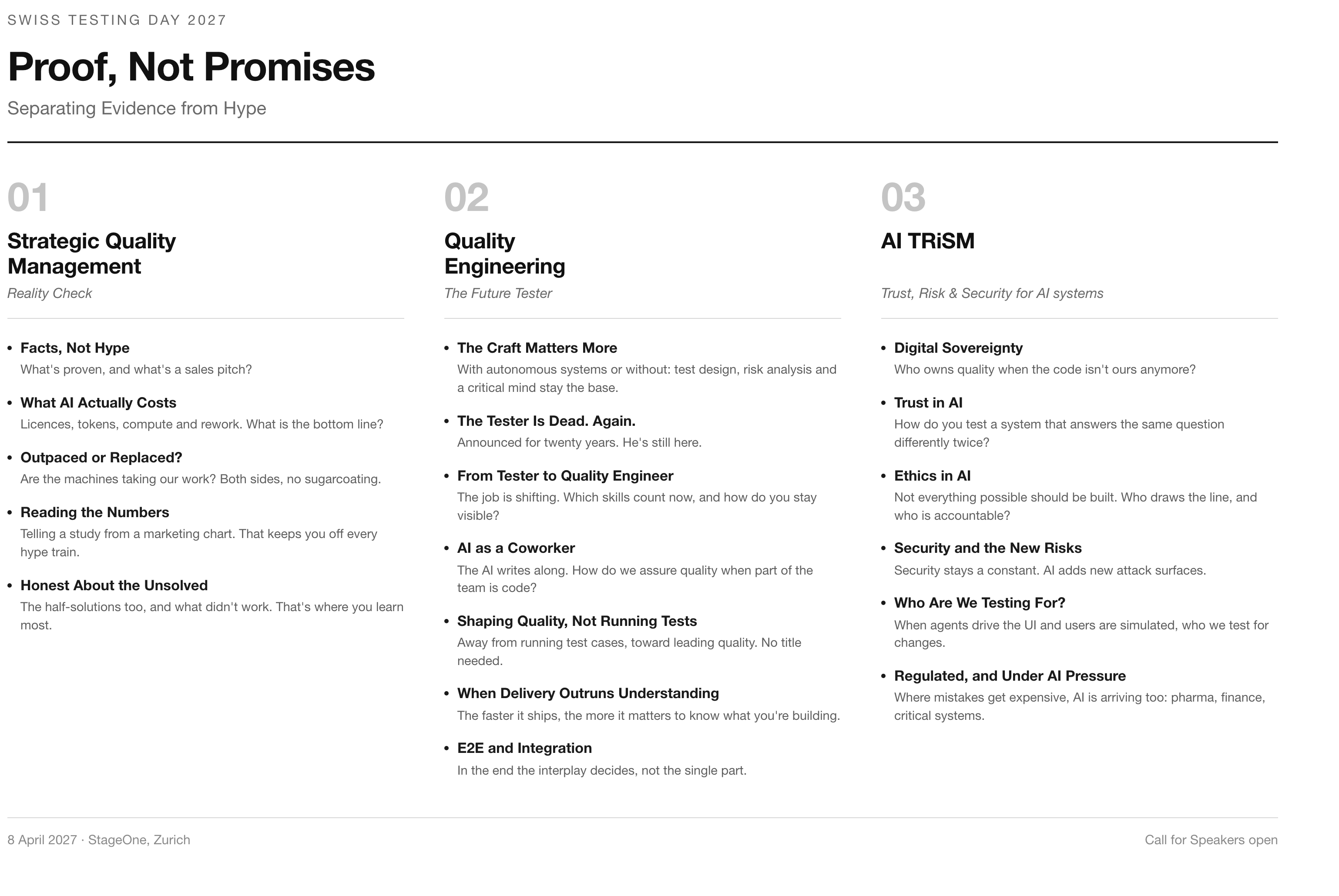
Pillar 1: Strategic Quality Management
The reality check from a leadership perspective. The first question of the balance sheet: What has actually worked?
Anyone responsible for a budget knows the task: telling promises apart from results. That has become harder over the last two years, not easier. But it has also become more interesting, because those who look closely today find things hardly anyone knows.
Take this one: a METR study measured experienced open-source developers working with AI assistance. They took 19 percent longer, not shorter. The real find sits in the detail: beforehand, the participants expected to be considerably faster. Perceived and measured productivity are two different things, and only one of them belongs in a business case. Once you have seen that, you read every success story differently.
Or take the benchmarks. The Stanford AI Index 2026 documents a jump on SWE-bench Verified from around 60 to nearly 100 percent within a single year. Sounds like a solved problem. Yet on the harder SWE-Bench Pro, several top scores circulate for the same leading models at the same time, anywhere between roughly 47 and 80 percent depending on the test setup. And most people who quote one of those numbers never say which one they mean. See through that, and you decide better. These are exactly the aha moments we want to share on 8 April.
This is your stage if you have an ROI calculation that survives scrutiny. A metric that actually says something about quality. The real costs of AI across licences, tokens and rework. A way to tell a study from a marketing chart. Or the project where the tooling did not deliver what the vendor promised. Especially that one.
Pillar 2: Quality Engineering
The future tester. The second question: Who can show it, and with what craft?
The tester has been declared obsolete for twenty years. Agile was going to do it, then test automation, then DevOps, now AI. The tester is still here. The pressure is real, though: the Stanford AI Index 2026 reports that employment of young software developers aged 22 to 25 has fallen by almost 20 percent since 2024. Which makes the survival question the wrong one, not just the boring one. The right one is: What can this profession do that is becoming more valuable right now?
The answer comes, of all places, from a cancellation statistic. Gartner expects more than 40 percent of agentic AI projects to be cancelled by the end of 2027. Whether that comes true will be decided in the very year of our conference. The most common reason is neither the technology nor model quality, but unclear business value. These projects fail on the question of what the system is actually supposed to do, and on the absence of anyone answering it. That is the best news in this text: asking exactly that question is our craft.
And that craft is growing. ISTQB has introduced dedicated certifications with CT-AI and, approved in 2025, CT-GenAI: non-determinism, bias, metrics. What was specialist knowledge yesterday is exam material today. The DORA report 2025 puts it plainly: AI amplifies what is already there. Strong teams get better faster. If you look after your foundation, AI is a lever, not a threat.
This is your stage if you practise test design and risk analysis under real time pressure. If you work with AI as a team member and know where it struggles. If you have identified requirements and UAT as the real bottleneck. If you have made the move from processing test cases to leading quality, even without the title. Or if you can show which skills genuinely count now.
Pillar 3: AI TRiSM
Trust, risk and security for AI systems. The third question: What are we building on, and whom do we trust?
Research presented at USENIX Security 2025 works from the assumption that 97 percent of developers use generative AI in their daily work and that roughly 30 percent of the code written today comes from it. That is not a fringe phenomenon, it is the norm. We increasingly test systems whose parts we did not write and whose origin we only partly know. You can find that unsettling. Or you can recognise it as the most interesting new field our profession has been handed in a long time.
Because the questions arising now are genuine pioneer questions. How do you prove a system does what it should when it answers the same question differently twice? Who carries responsibility when the code comes from outside? And what does that mean where mistakes get genuinely expensive, in pharmaceuticals, finance and critical infrastructure? Whoever develops answers here today is co-writing tomorrow’s standards.
We deliberately separate two things that often get merged. Trust is a technical question: verification, robustness, traceability. Ethics is a governance question: what should a system be allowed to do, and who is accountable? Both appear as separate topics in the 2027 programme. For a deeper read, Xebia has published a guide for business leaders.
This is your stage if you verify non-deterministic systems, secure supply chains in code, know the security risks agents bring, put observability and evidence obligations into practice, or test in regulated environments where every mistake counts.
What We Are Setting Out To Do
Two years ago we said the next five years would define the next fifty. We stand by that. In 2027 we will take stock together of where we are.
Above it all sits the question that runs through all three pillars: Has quality actually improved? We do not have an answer yet. But we know how to find one: together, with evidence.
Nobody closes the gap between 89 and 15 percent alone. A room full of people sharing their experience openly is the best start we know. Bring yours. The number that surprised you. The experiment that did not work out. The question you have no answer to yet.
On 8 April 2027, we pool what we know.Proof, not promises.
Call For Speakers is Open
We set the direction, you fill it. The pillars guide our selection, they are not a fence. If your topic sits between them: submit it anyway. Some of the best conversations happen exactly between the categories. A project with numbers behind it beats a well-told story without them. We check sources, including our own. If you bring a number, please also bring where it came from.
Partial solutions, open questions and experiments that did not work out are explicitly welcome, provided you can say why. There is rarely a stage for those talks. Here they get a place of honour, because they are what the room learns from most.You do not need a finished transformation.
You do not need a title that entitles you to speak. You need a case that makes people think.
Early Bird Tickets Available
There is one day a year when the Swiss testing community comes together in one place. The next one is 8 April 2027 at StageOne in Zurich. One day, one place, the full programme. And in between, the part no recording captures: the coffee-break conversations that often produce more than some slides do.
Early Bird tickets are available now. The contingent is limited, and once it is gone the regular price applies. If your training budget for next year is already approved, this is the moment to secure your seat at the best price.
Sources
– Capgemini, World Quality Report 2025-26, latest edition (17th, December 2025): 89 percent adoption, 15 percent scaled, 19 percent productivity gain
– METR, Early 2025 AI Experienced OS Dev Study: 19 percent longer completion time
– Stanford HAI, AI Index 2026: SWE-bench Verified from around 60 to nearly 100 percent; employment of developers aged 22 to 25 down almost 20 percent since 2024
– Scale AI, SWE-Bench Pro Leaderboard: top scores between roughly 47 and 80 percent depending on the test setup
– Gartner, Press Release June 2025: over 40 percent project cancellationsISTQB, CT-AI and CT-GenAI
– DORA 2025, summarised by InfoQ
– Spracklen et al., USENIX Security 2025: 97 percent developer adoption, 30 percent AI-generated code
Swiss Testing Day 2027
8 April 2027 · StageOne, Zurich Call for Speakers
sessionize.com/swiss-testing-day-2027