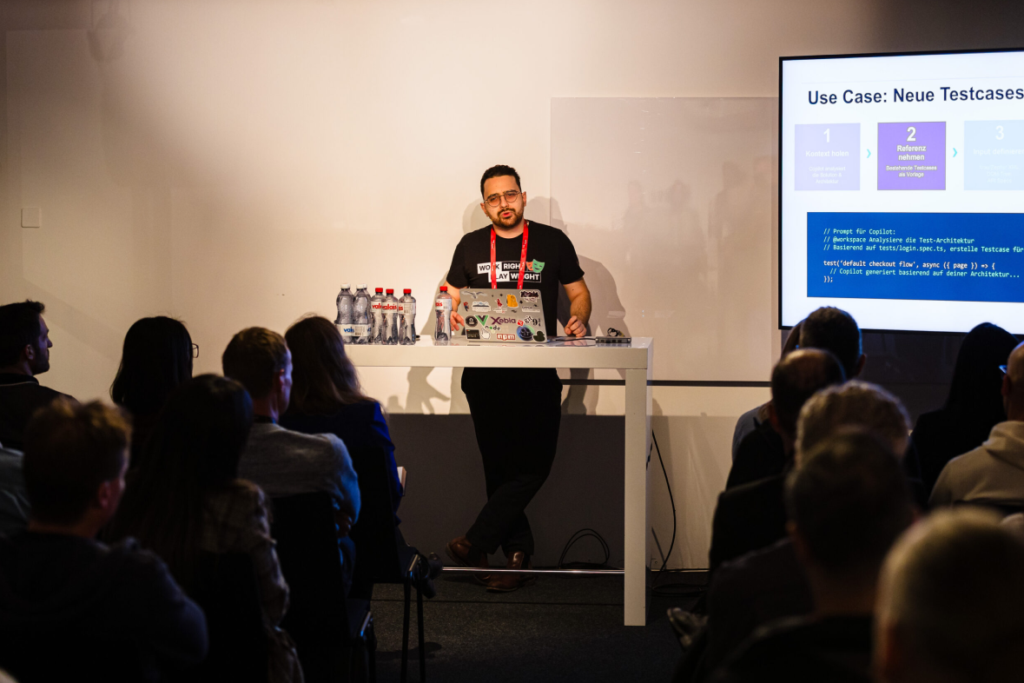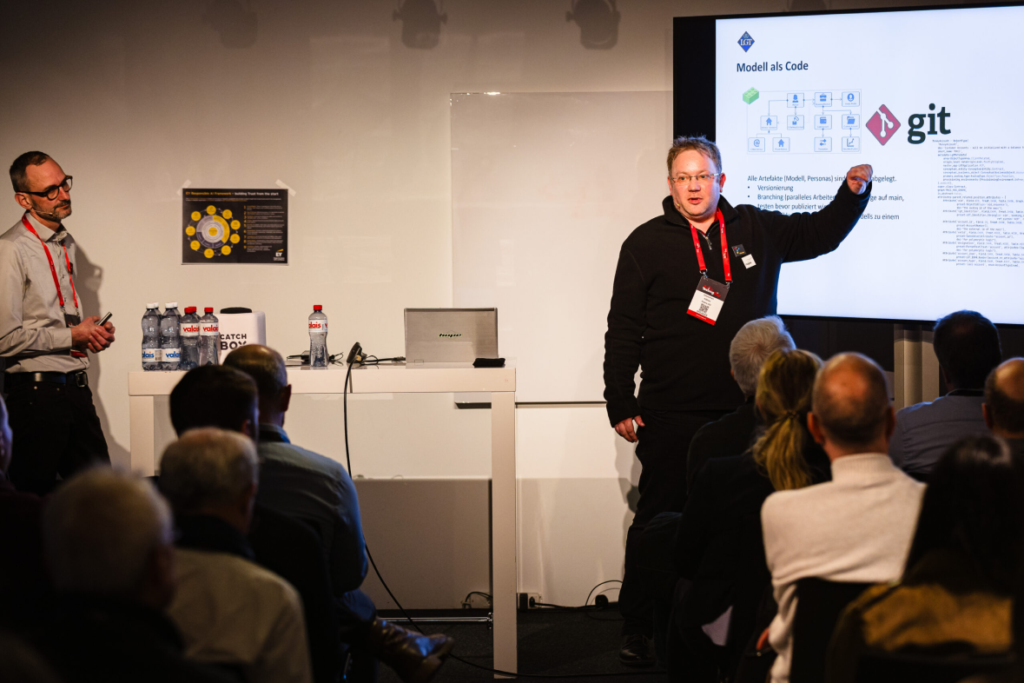
What happens when you give testers a “magic button” that fixes bugs via AI agent — no developer, no IDE, no sprint planning? Deutsche Telekom tried it and shows: it works, but you need more than just a tool.
Key Takeaways
- Testers need AI as autopilot, not copilot: No IDE needed, just a browser. GitLab Duo enables one-click bug fixing directly from the ticket
- From 8 to 2 minutes: AI fix time improved automatically through better LLMs without any effort from the team
- Simple bugs get solved immediately: Wrong UI texts, formatting errors, sorting issues, and simple logic bugs. All autonomously fixable
- Bug tickets must be written AI-optimized: No screenshots, instead exact UI texts and more context than usual
- The process changes fundamentally: Prioritization, sprint planning, and developer assignment are completely eliminated for simple bugs
The Problem: Weeks for a Typo
Everyone knows it: a tester finds a bug; a wrong error message, a sorting issue, a formatting error. The bug goes into Jira, the product owner prioritizes it (maybe), a developer picks it up (eventually), the fix gets deployed, the tester retests. Duration: days to weeks. Sometimes months. Sometimes never.
Elmar Brauch, AI Architect at Deutsche Telekom IT, and Mariia Afanaseva, test expert at T-Digital/Deutsche Telekom IT Greece, showed at Swiss Testing Day 2026 how they turned this process upside down with a “lighthouse project” that empowers testers to fix bugs themselves.
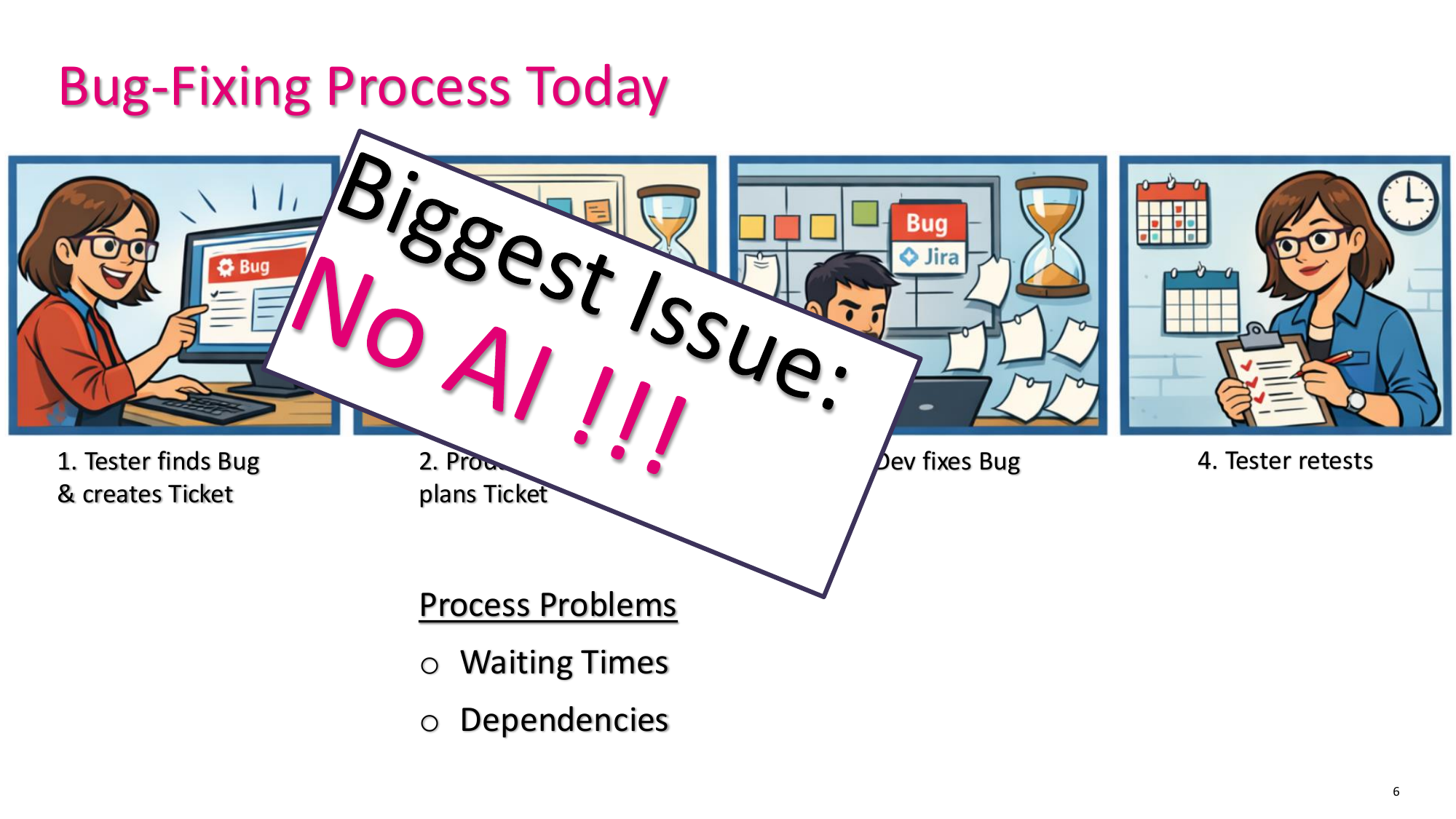
The previous process: 4 steps, multiple dependencies, long waiting times — and the “biggest problem” according to management: no AI in the process.
Copilot vs. Autopilot: Why Testers Need a Different AI Model
A key insight from the talk: for developers, AI works excellently as a copilot: they write code, AI assists. Testers, however, typically don’t write code and often don’t have their own IDE. They need AI as an autopilot.
“My understanding of a tester is that you don’t write code. Maybe you don’t even have your own IDE. You are just verifying and testing. That’s why the tester needs the AI tool to work as an autopilot.” — Elmar Brauch
That’s exactly what GitLab Duo delivers: a button in the browser, one click, and the AI agent analyzes the bug, creates a fix, commits it, and generates a merge request — all without an IDE, all without coding knowledge.
Live Demo: 10 Minutes from Bug to Fix
Mariia showed a video recording of the process: a wrong error message in the production application. She created a ticket in GitLab, clicked “Generate Merge Request with Duo,” and the agent started:
- Empty merge request created
- Agent analyzes the bug and forms a hypothesis
- Agent finds the missing error text in the code
- Commit created and pushed
- Mariia deploys the branch to test environment
- Manual retest: error text is correct
- Commit message adjusted (team convention)
Total duration: approximately 10 minutes, including all waiting times. The same bug would have spent weeks in the backlog in the classic process.
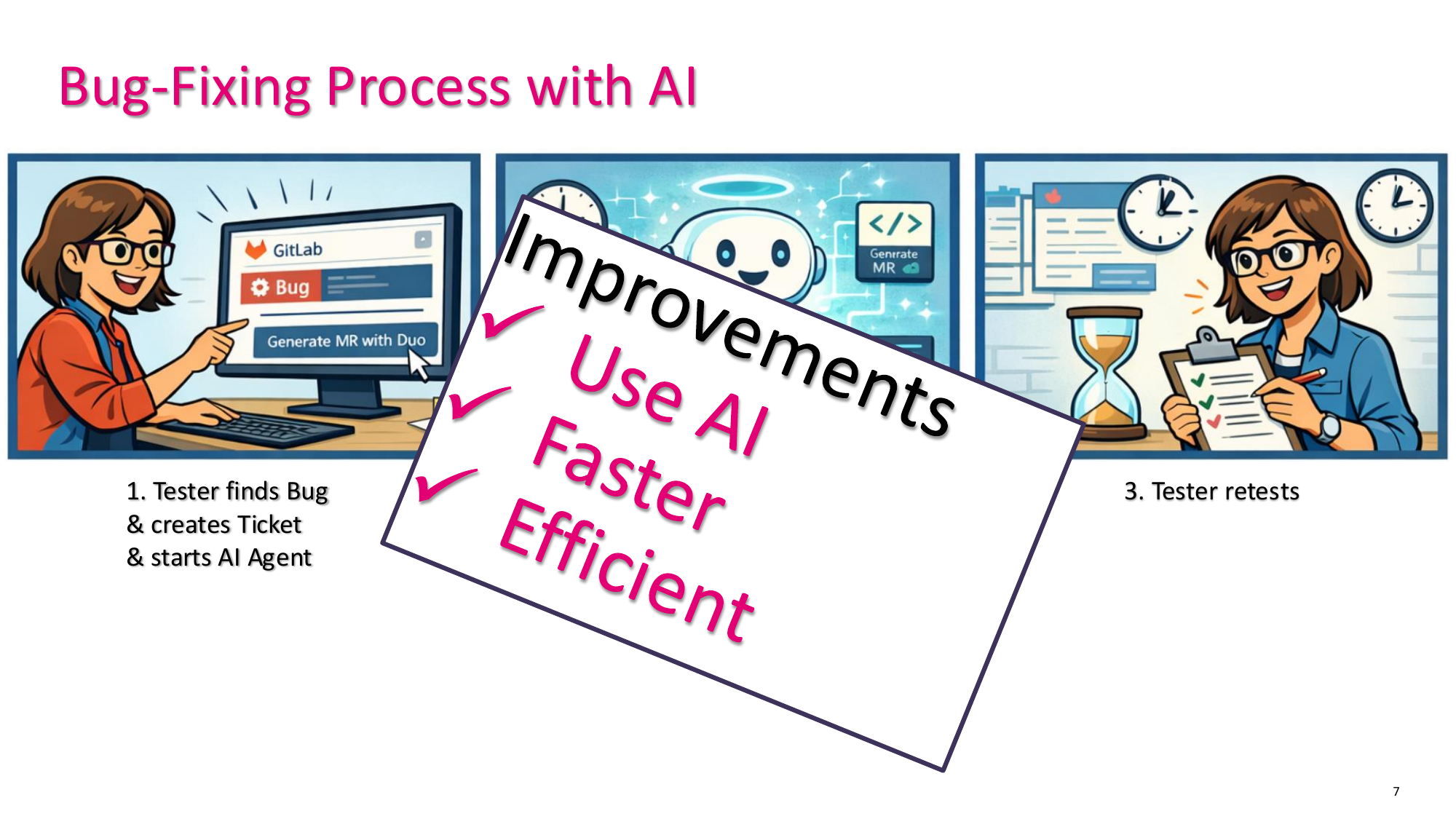
The new process: tester finds bug, starts AI agent, retests. Developer and product owner are no longer in the loop for simple bugs.
What AI Can Fix Autonomously — and Where It Fails
The team has been testing the AI in productive use since October/November 2025. The application: a B2B web portal with approximately 50,000 lines of Java (backend: Spring, MongoDB, REST/SOAP) and approximately 10,000 lines of TypeScript/Vue.js (frontend).
Autonomously solvable:
- Wrong texts in the UI
- Formatting errors
- Wrong orderings
- Logic bugs covered by simple unit tests
Problematic:
- Code with complex unit tests (many dependencies, multiple mocks, database dependencies)
- Poor bug descriptions
The solution for the latter: write bug tickets optimized for AI. No screenshots (even though LLMs can read images), but exact texts as they appear in the UI. More context than usual. The AI searches the code for exactly these texts and thus finds the bug source.
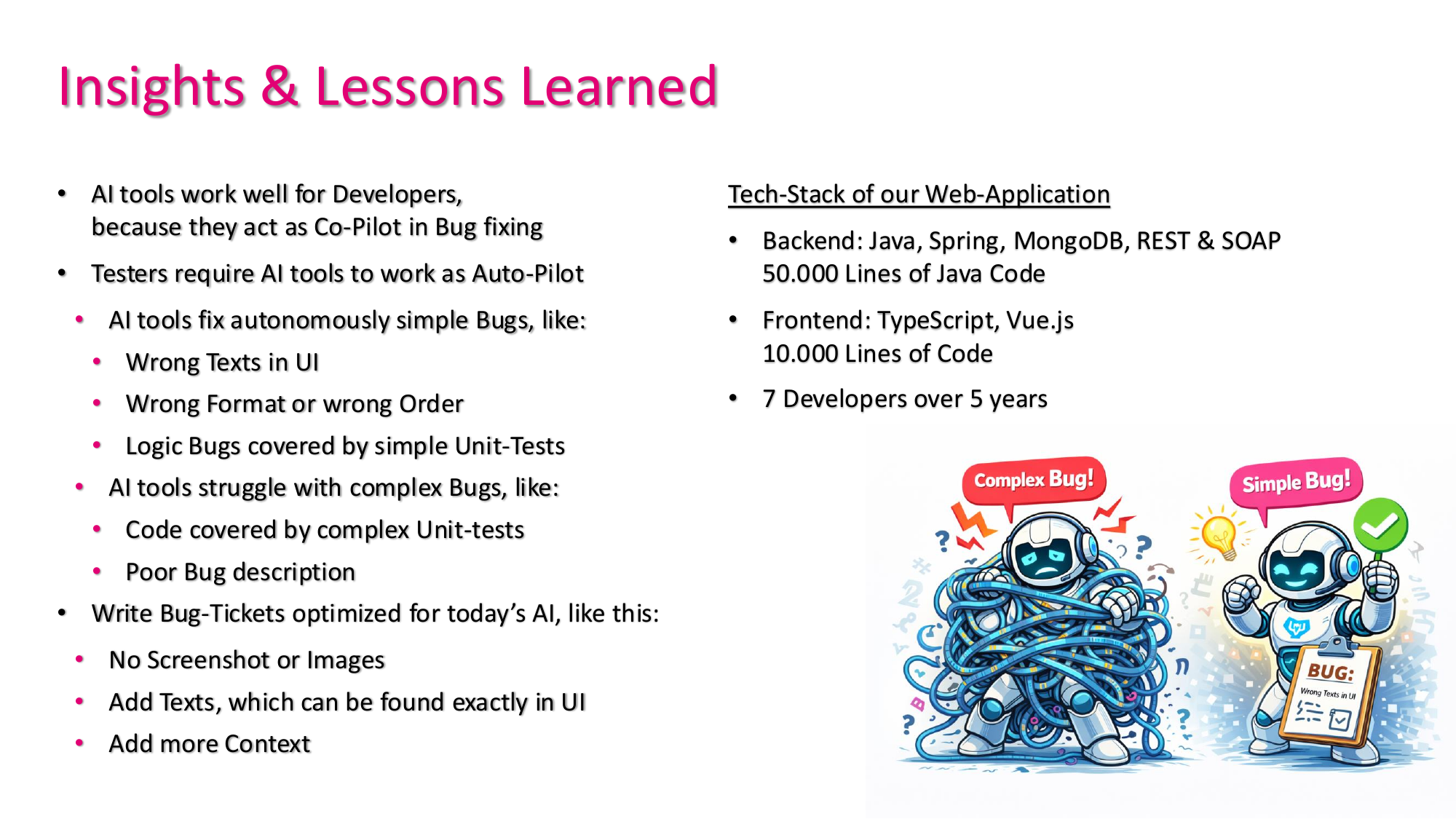
Detailed insights: AI as copilot for devs vs. autopilot for testers, what’s autonomously fixable, and how to write bug tickets.
The Elephant in the Room: Prioritization Drops Away
One of the most exciting Q&A questions concerned the skipped prioritization. Elmar was direct:
“Sometimes you discuss a bug ticket way more often with all the people in these planning meetings, losing the time, until it’s decided when we fix it — then just fixing it. The tester finds the bug and just fixes it. In best case, afterwards no one has to discuss it.”
This is a fundamental culture shift: instead of pushing bugs through the entire planning process, simple bugs get solved immediately. The rule of thumb for merging: if little has changed and the test passed, the tester can merge themselves. If the AI “ran wild” and changed many files, the merge request goes to a developer.
Outlook: Spec-Driven Development
Elmar looked into the future: spec-driven development — the idea that you only write a specification, AI codes everything, and then verification happens. Verification is testing. In this scenario, the tester with an AI agent might not need a developer even for new features.
And if you don’t have GitLab Duo? No problem: Claude Code CLI or GitHub Copilot CLI can be connected to Jira via MCP. A command like “Fix bug ticket 12345” is enough, and the agent reads the ticket and starts the fix.
What Does This Mean for Your Team?
- Start now: You don’t need a perfect setup. If your code is in GitLab, you can activate GitLab Duo tomorrow. If not, a CLI tool with MCP connection is sufficient.
- Rewrite bug tickets: Invest in precise, text-based bug descriptions without screenshots. It pays off immediately.
- Accept the limits: AI doesn’t fix everything. But every bug that no longer needs to be discussed in the backlog saves sprint capacity.
- Rethink the roles: When testers can fix bugs, the focus of developers shifts to more complex tasks.
- Keep going: From 8 to 2 minutes in a few months — the tools are getting faster. Waiting doesn’t pay, starting does.
Speakers
Elmar Brauch — Software Developer & AI Catalyst at Deutsche Telekom IT. Agile software development since 2010, focus on AI, Java, Spring, and Clean Code. Blog: agile-coding.blogspot.com | YouTube: @elmarbrauch
Mariia Afanaseva — Test Expert at T-Digital / Deutsche Telekom IT Greece. Over 10 years of experience in software testing (UI, API, manual & automation).
Wenn Tester Bugs fixen: Wie Deutsche Telekom mit Agentic AI den Bug-Fixing-Prozess revolutioniert
Was passiert, wenn man Testern einen “Magic Button” gibt, der Bugs per AI-Agent direkt fixt — ohne Entwickler, ohne IDE, ohne Sprint-Planung? Deutsche Telekom hat es ausprobiert und zeigt: Es funktioniert, aber es braucht mehr als nur ein Tool.
Key Takeaways
- Tester brauchen AI als Autopilot, nicht als Copilot: Ohne IDE, nur im Browser: GitLab Duo ermöglicht One-Click-Bug-Fixing direkt aus dem Ticket heraus
- Von 8 auf 2 Minuten: Die AI-Fix-Zeit hat sich durch bessere LLMs automatisch verbessert ohne eigenes Zutun des Teams
- Einfache Bugs werden sofort gelöst: Falsche UI-Texte, Formatierungsfehler, Sortierprobleme und einfache Logikfehler, alles autonom fixbar
- Bug-Tickets müssen AI-optimiert geschrieben werden: Keine Screenshots, stattdessen exakte UI-Texte und mehr Kontext als üblich
- Der Prozess ändert sich fundamental: Priorisierung, Sprint-Planung und Entwickler-Zuweisung entfallen für einfache Bugs komplett
Das Problem: Wochen für einen Tippfehler
Jeder kennt es: Ein Tester findet einen Bug; eine falsche Fehlermeldung, ein Sortierungsproblem, ein Formatierungsfehler. Der Bug wandert ins Jira, der Product Owner priorisiert ihn (vielleicht), ein Entwickler nimmt ihn auf (irgendwann), der Fix wird deployed, der Tester retestet. Dauer: Tage bis Wochen. Manchmal Monate. Manchmal nie.
Elmar Brauch, AI Architect bei Deutsche Telekom IT, und Mariia Afanaseva, Test-Expertin bei T-Digital/Deutsche Telekom IT Greece, haben am Swiss Testing Day 2026 gezeigt, wie sie diesen Prozess auf den Kopf gestellt haben – mit einem “Lighthouse Project”, das Tester befähigt, Bugs selbst zu fixen.
Der bisherige Prozess: 4 Schritte, multiple Abhängigkeiten, lange Wartezeiten — und das “grösste Problem” laut Management: keine AI im Prozess.
Copilot vs. Autopilot: Warum Tester ein anderes AI-Modell brauchen
Eine zentrale Erkenntnis des Talks: Für Entwickler funktioniert AI hervorragend als Copilot — sie schreiben Code, AI unterstützt. Tester hingegen schreiben typischerweise keinen Code und haben oft keine eigene IDE. Sie brauchen AI als Autopilot.
“My understanding of a tester is that you don’t write code. Maybe you don’t even have your own IDE. You are just verifying and testing. That’s why the tester needs the AI tool to work as an autopilot.” — Elmar Brauch
Genau das liefert GitLab Duo: Ein Button im Browser, ein Klick, und der AI-Agent analysiert den Bug, erstellt einen Fix, committet ihn und erzeugt einen Merge Request — alles ohne IDE, alles ohne Coding-Kenntnisse.
Live-Demo: 10 Minuten vom Bug zum Fix
Mariia zeigte live eine Videoaufnahme des Prozesses: Eine falsche Fehlermeldung in der Produktiv-Applikation. Sie erstellte ein Ticket in GitLab, klickte auf “Generate Merge Request with Duo”, und der Agent startete:
- Leerer Merge Request wird erstellt
- Agent analysiert den Bug und bildet eine Hypothese
- Agent findet den fehlenden Fehlertext im Code
- Commit wird erstellt und gepusht
- Mariia deployed den Branch in die Testumgebung
- Manueller Retest: Fehlertext ist korrekt
- Commit-Message angepasst (Team-Konvention)
Gesamtdauer: ca. 10 Minuten, inklusive aller Wartezeiten. Der gleiche Bug hätte im klassischen Prozess Wochen im Backlog verbracht.
Der neue Prozess: Tester findet Bug, startet AI-Agent, retestet. Entwickler und Product Owner sind für einfache Bugs nicht mehr im Loop.
Was AI autonom fixen kann — und wo sie scheitert
Das Team hat die AI seit Oktober/November 2025 im produktiven Einsatz getestet. Die Applikation: ein B2B-Webportal mit ca. 50.000 Zeilen Java (Backend: Spring, MongoDB, REST/SOAP) und ca. 10.000 Zeilen TypeScript/Vue.js (Frontend).
Autonom lösbar:
- Falsche Texte in der UI
- Formatierungsfehler
- Falsche Sortierungen
- Logikbugs, die von einfachen Unit-Tests abgedeckt sind
Problematisch:
- Code mit komplexen Unit-Tests (viele Dependencies, mehrere Mocks, Datenbank-Abhängigkeiten)
- Schlechte Bug-Beschreibungen
Die Lösung für letzteres: Bug-Tickets AI-optimiert schreiben. Keine Screenshots (auch wenn LLMs Bilder lesen können), sondern exakte Texte wie sie in der UI erscheinen. Mehr Kontext als üblich. Die AI sucht im Code nach genau diesen Texten und findet so die Bug-Quelle.
Die Insights im Detail: AI als Copilot für Devs vs. Autopilot für Tester, was autonom fixbar ist, und wie man Bug-Tickets schreiben sollte.
Der Elefant im Raum: Priorisierung entfällt
Eine der spannendsten Q&A-Fragen betraf die übersprungene Priorisierung. Elmar war direkt:
“Sometimes you discuss a bug ticket way more often with all the people in these planning meetings, losing the time, until it’s decided when we fix it — then just fixing it. The tester finds the bug and just fixes it. In best case, afterwards no one has to discuss it.”
Das ist ein fundamentaler Kulturwandel: Statt Bugs durch den gesamten Planungsprozess zu schleusen, werden einfache Bugs sofort gelöst. Die Faustregel für den Merge: Wenn wenig geändert wurde und der Test bestanden ist, kann der Tester selbst mergen. Wenn die AI “wild gelaufen” ist und viele Dateien verändert hat, geht der Merge Request an einen Entwickler.
Ausblick: Spec-Driven Development
Elmar wagte einen Blick in die Zukunft: Spec-Driven Development. Die Idee, dass man nur noch eine Spezifikation schreibt, AI alles codiert, und danach verifiziert wird. Verifikation ist Testing. In diesem Szenario braucht der Tester mit AI-Agent vielleicht auch für neue Features keinen Entwickler mehr.
Und wer kein GitLab Duo hat? Kein Problem: Claude Code CLI oder GitHub Copilot CLI lassen sich über MCP mit Jira verbinden. Ein Befehl wie “Fix bug ticket 12345” reicht, und der Agent liest das Ticket und startet den Fix.
Was bedeutet das für Ihr Team?
- Starten Sie jetzt: Sie brauchen kein perfektes Setup. Wenn Ihr Code in GitLab liegt, können Sie GitLab Duo morgen aktivieren. Wenn nicht, reicht ein CLI-Tool mit MCP-Anbindung.
- Schreiben Sie Bug-Tickets neu: Investieren Sie in präzise, textbasierte Bug-Beschreibungen ohne Screenshots. Das zahlt sich sofort aus.
- Akzeptieren Sie die Grenzen: AI fixiert nicht alles. Aber jeder Bug, der nicht mehr im Backlog diskutiert werden muss, spart Sprint-Kapazität.
- Überdenken Sie die Rollen: Wenn Tester Bugs fixen können, verschiebt sich der Fokus der Entwickler auf komplexere Aufgaben.
- Bleiben Sie dran: Von 8 auf 2 Minuten in wenigen Monaten. Die Tools werden schneller. Warten lohnt nicht, Starten schon.
Speaker
Elmar Brauch: Software Developer & AI Catalyst bei Deutsche Telekom IT. Agile Softwareentwicklung seit 2010, Fokus auf AI, Java, Spring und Clean Code. Blog: agile-coding.blogspot.com | YouTube: @elmarbrauch
Mariia Afanaseva: Test Expert bei T-Digital / Deutsche Telekom IT Greece. Über 10 Jahre Erfahrung in Software Testing (UI, API, Manual & Automation).
Dieser Beitrag basiert auf der Session “When Testers Fix Bugs with Agentic AI” am Swiss Testing Day 2026, 26. März 2026, StageOne Zürich. Konferenz-Motto: “Defining Quality in a Dangerous Decade.”