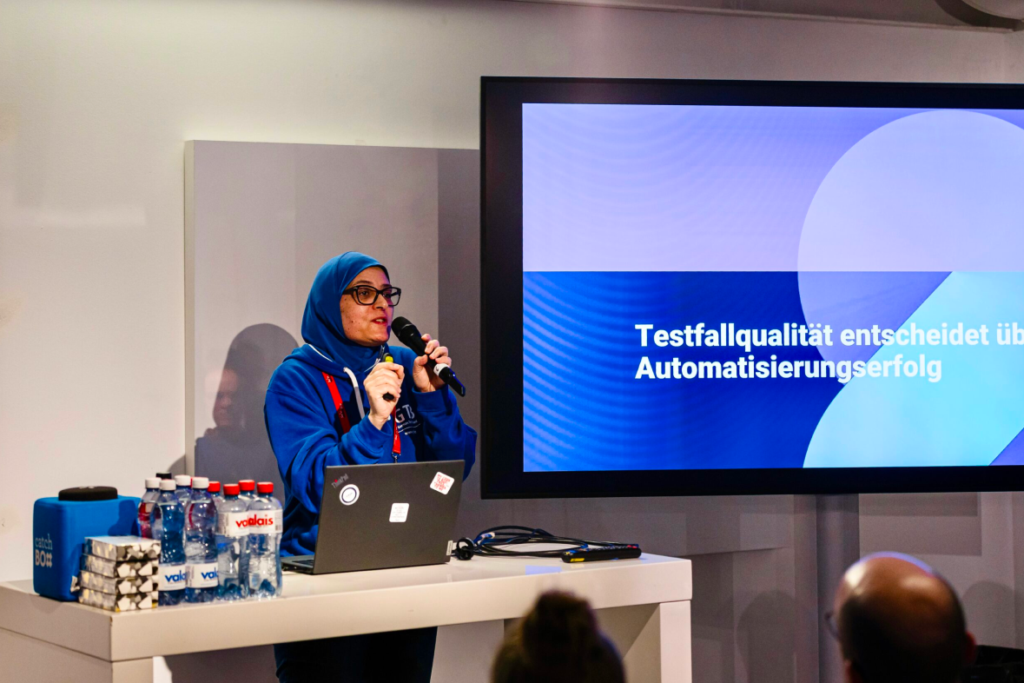
Lilia Gargouri, Head of QA at mgm technology partners, has test-automated 32+ business applications. Her conclusion: Efficiency in test automation is not a coincidence, but the result of many small, well-thought-out decisions. Here’s the distillate.
Key Takeaways
- Test automation is software development: Without architecture, clean code, and design patterns, any automation is just expensive, not valuable
- Component recognition is the Achilles heel: A dedicated HTML attribute for tests, consistent across the entire application, is the foundation for stability
- Thinking comes before automating: Test scenario, test data, and implementation form three equal pillars. Neglecting one makes automation expensive rather than valuable
- 8 concrete measures for faster test execution: From removing redundant tests to random browser: a systematic optimization path
- AI generates code, not engineering: Juniors should learn the hard way first before evaluating AI-generated code
The Achilles Heel: Stable Component Recognition
Lilia Gargouri makes it clear right from the start: her talk is exclusively about end-to-end test automation at the top of the test pyramid — WebUI. And she doesn’t begin with tools or frameworks but with what most teams underestimate: the stable identification of UI elements.
At mgm technology partners, a dedicated HTML attribute was introduced in 2017 — exclusively for testing purposes. The rules are simple and non-negotiable: every UI element must have the attribute. If it’s missing, it’s a defect. It’s consistent across the entire application. It must not be changed.
Building on this, the team developed a “Custom Web Resolver” — a centralized software solution loaded once after opening the browser that intelligently identifies all UI components. By extracting labels and accessibility attributes, the team even implicitly tests accessibility as a side effect.
“There are eight approaches just for component recognition — and we haven’t even started automating yet.”
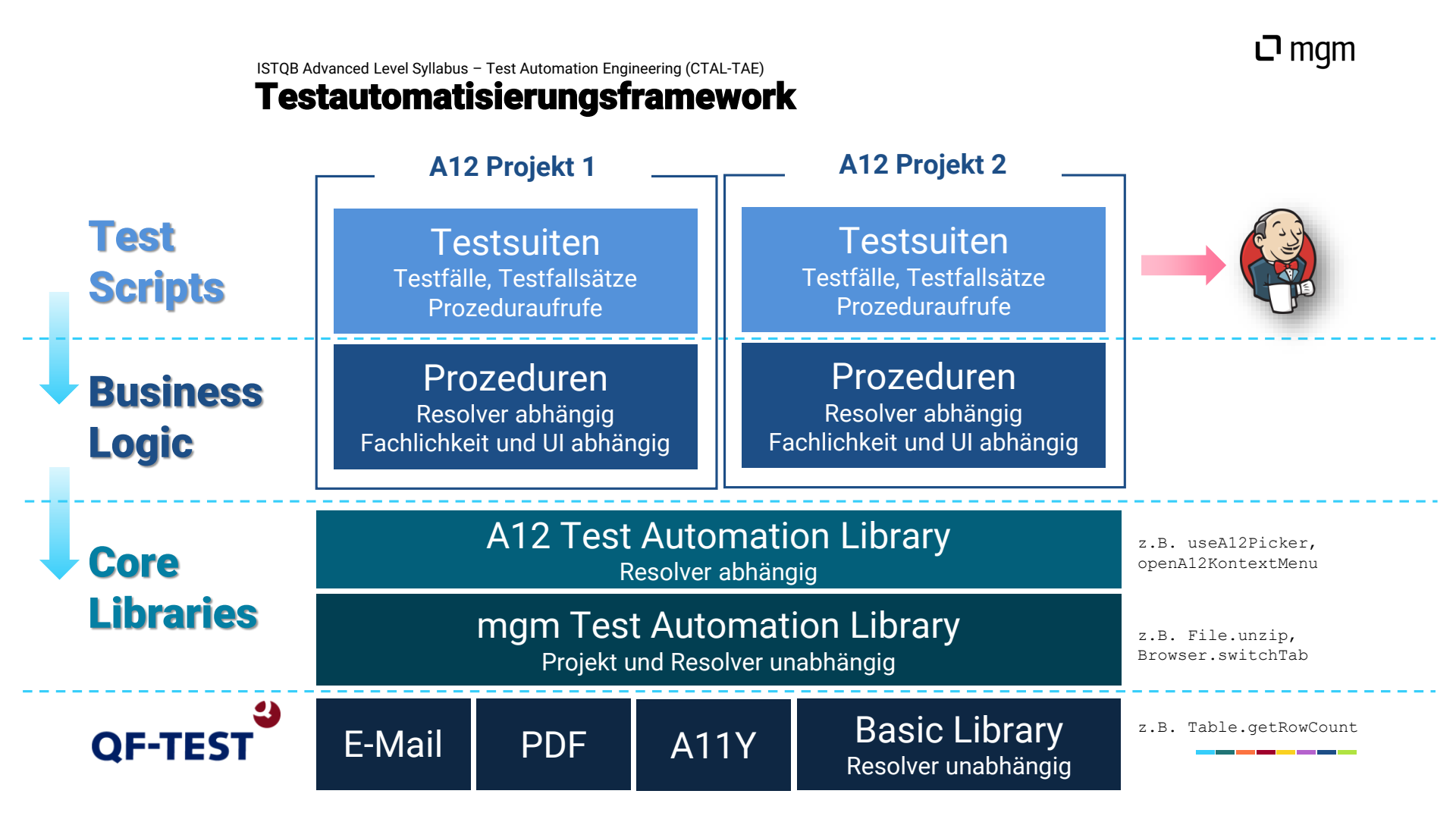
The test automation framework at mgm: Three layers. Core Libraries (project- and resolver-independent), Business Logic (domain-dependent), Test Scripts (test suites with procedure calls).
Three Pillars of a Test Case — Before Automating
Before a single line of automation code is written, Lilia demands three well-thought-out pillars per test case:
- Test scenario: Why do I need this test case? What does it cover? Where’s the value? Question critically and trim.
- Test data: Equivalence classes, boundary value analysis. If the scenario is valuable but the test data is “123 ABC,” the entire value is destroyed.
- Implementation: Clean code, modularization, naming conventions.
Backlog prioritization follows strategic criteria: manually time-consuming tests, business-critical functionality, high repetition rate, processes with high error potential; and always the ROI.
Test Automation Is Software Development
“If you forget the entire talk, at least take this sentence with you: Test automation is software development in the truest sense of the word.”
The framework at mgm follows a three-layer architecture that harmonizes with ISTQB Test Automation Advanced: Core Libraries (tool-level, project-independent), Business Logic (domain procedures), Test Scripts (test suites with procedure calls and test data). The naming convention is radically simple: Action + Domain Term. Action can only be Enter, Check, or Click. The technical nature of the UI element is irrelevant — only the business domain appears in the code.
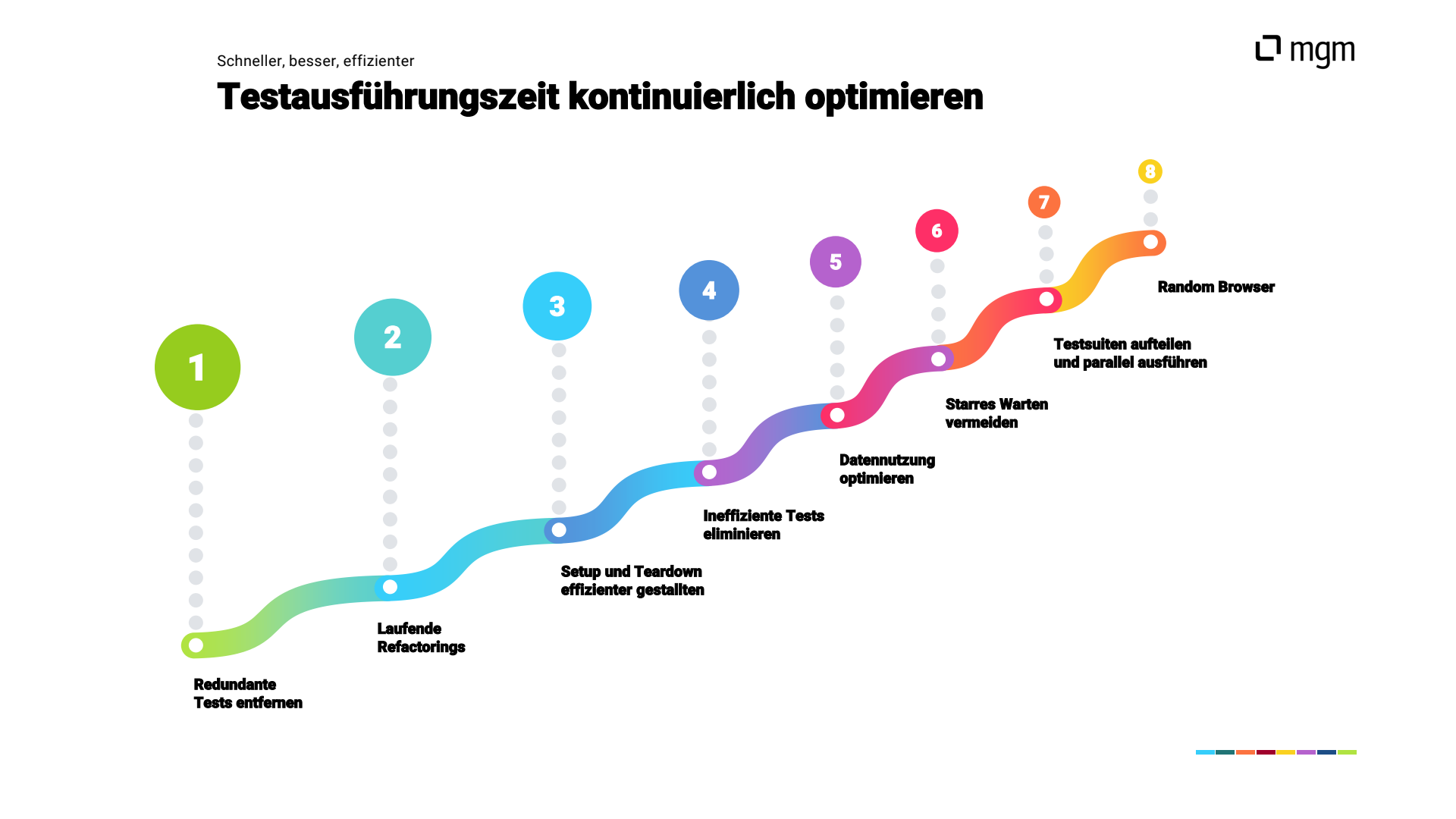
The optimization path: From removing redundant tests through refactorings to random browser. Eight concrete measures for faster, leaner test execution.
AI: Coding Yes, Engineering No
On the topic of AI in test automation, Lilia has a clear position: AI generates code, but not engineering. Anyone who can’t assess architecture, maintainability, and scalability themselves will only produce technical debt with AI assistance. Her advice to juniors on the team: “No Cloud Code for the next six months. You learn it the hard way.”
Stable, Flexible, Fast — The Three Dimensions of Test Execution
Stable: Reliable component recognition, active waiting instead of rigid waits, a busy detector for the application, a current test environment, and no competing activities during test runs.
Flexible: Every test case is a modular unit. Test suites are modular, named by domain, with upper limits (max. 5 minutes per test case, max. 1 hour per suite). Suites that are too large get split, allowing impact-based execution at any time.
Fast: Eight concrete optimization measures: remove redundant tests, continuous refactoring, more efficient setups and teardowns, eliminate inefficient tests, optimize data usage, avoid rigid waiting, split and run suites in parallel, and random browser for cross-browser testing.
The Human Factor: Four Languages Simultaneously
Finally, an often overlooked aspect: test automation engineers speak four languages simultaneously in daily work — the domain language of their project, technical language, the language of software testing (ISTQB), and the project language (soft skills). Deficiencies in any of these cost efficiency and lead to misunderstandings. Lilia’s advice to team leads: identify the deficiencies and provide training.
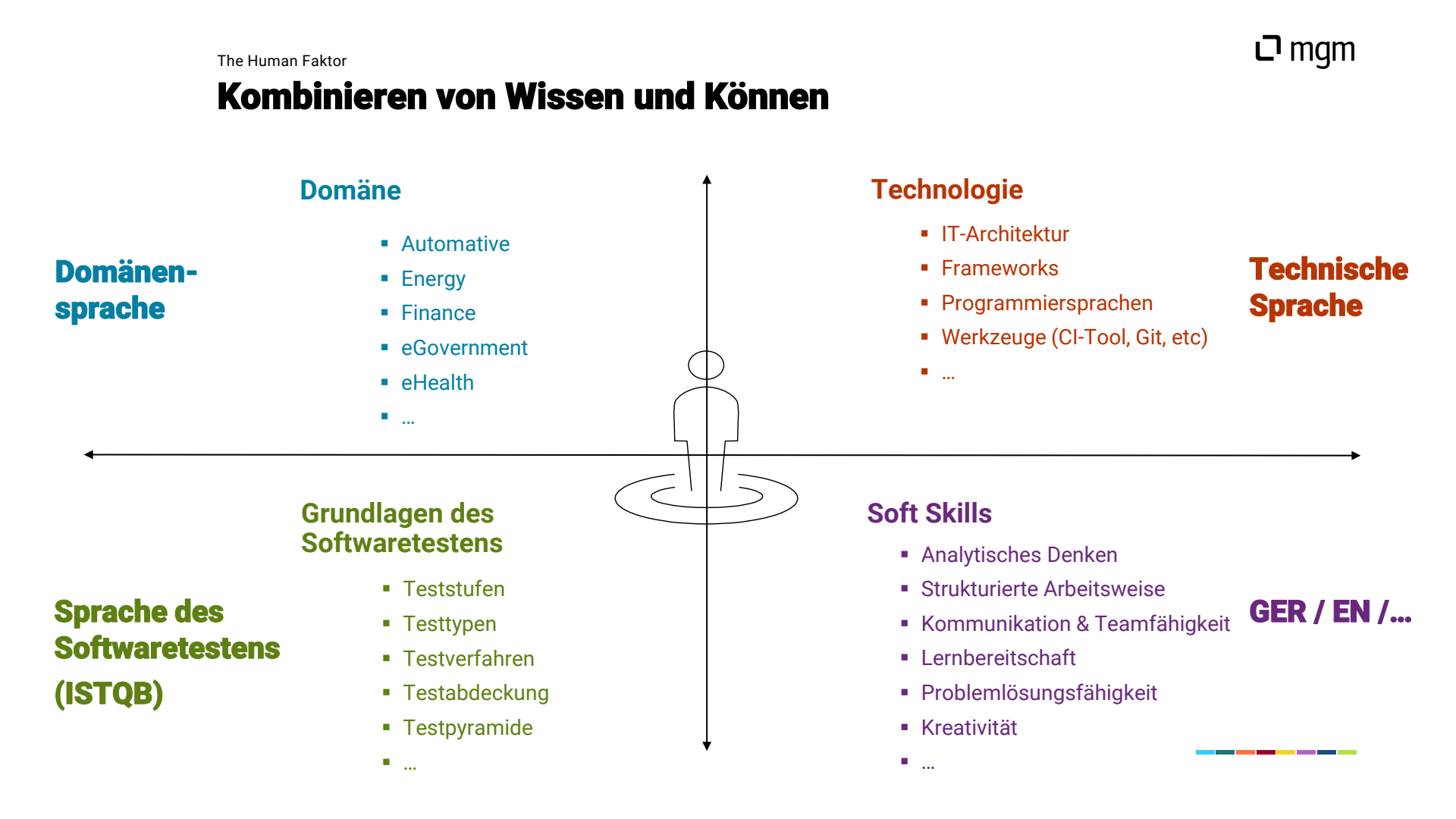
Domain language, Technical language, Language of Software Testing (ISTQB), and Soft Skills — all four must be mastered.
What Does This Mean for Your Team?
- Invest in the fundamentals: Stable component recognition, clean architecture, and well-designed test cases matter more than the tool.
- Automation needs engineering: Those who “just automate” without architecture, conventions, and modularization build technical debt.
- Optimize continuously: Test coverage grows, but execution time must remain acceptable. That only works through active maintenance.
- Question AI-generated code: AI can accelerate, but only when the team masters the engineering itself.
- Don’t forget the human factor: Language, soft skills, and domain understanding determine efficiency more than any tool.
Speaker
Lilia Gargouri — Head of QA at mgm technology partners. Member of the German Testing Board. 15 years of experience in software development, 12 years of expertise in quality assurance. Creator of “Automated Test Automation” (mgm Q12-ATA). Diplom-Informatikerin from Technical University of Braunschweig.
E2E-Testing ohne Schmerz: Wie 13 Jahre Erfahrung in 30 Minuten aussehen
Lilia Gargouri, Head of QA bei mgm technology partners, hat 32+ Geschäftsanwendungen testautomatisiert. Ihr Fazit: Effizienz in der Testautomatisierung ist kein Zufall — sondern das Ergebnis vieler kleiner, durchdachter Entscheidungen. Hier ist das Destillat.
Key Takeaways
- Testautomatisierung ist Softwareentwicklung: Ohne Architektur, Clean Code und Design Patterns ist jede Automatisierung nur teuer, nicht wertvoll
- Komponentenerkennung ist die Achillesferse: Ein dediziertes HTML-Attribut für Tests, konsistent über die gesamte Anwendung, ist die Grundlage für Stabilität
- Vor dem Automatisieren kommt das Denken: Testszenario, Testdaten und Umsetzung bilden drei gleichwertige Säulen — wer eine vernachlässigt, hat teure statt wertvolle Automatisierung
- 8 konkrete Maßnahmen für schnellere Testausführung: Von redundanten Tests entfernen bis Random Browser — ein systematischer Optimierungspfad
- KI generiert Code, kein Engineering: Juniors sollten erst die harte Tour lernen, bevor sie AI-generierten Code bewerten können
Die Achillesferse: Stabile Komponentenerkennung
Lilia Gargouri stellt gleich zu Beginn klar: Ihr Vortrag handelt ausschließlich von End-to-End-Testautomatisierung an der Spitze der Testpyramide — WebUI. Und sie beginnt nicht bei Tools oder Frameworks, sondern bei dem, was die meisten Teams unterschätzen: der stabilen Identifikation von UI-Elementen.
Bei mgm technology partners wurde 2017 ein dediziertes HTML-Attribut eingeführt — ausschließlich für Testzwecke. Die Regeln sind einfach und nicht verhandelbar: Jedes UI-Element muss das Attribut haben. Fehlt es, ist es ein Defekt. Es ist konsistent über die gesamte Anwendung. Es darf nicht verändert werden.
Darauf aufbauend hat das Team einen “Custom Web Resolver” entwickelt — eine zentrale Softwarelösung, die einmalig nach dem Öffnen des Browsers geladen wird und alle UI-Komponenten intelligent identifiziert. Durch die Extraktion von Labels und Accessibility-Attributen testet das Team sogar implizit Barrierefreiheit mit.
“Es gibt acht Ansätze allein für die Komponentenerkennung — und wir haben noch nicht angefangen zu automatisieren.”
Das Testautomatisierungsframework bei mgm: Drei Layers — Core Libraries (projekt- und resolver-unabhängig), Businesslogik (fachlichkeitsabhängig), Testskripts (Testsuiten mit Prozeduraufrufen).
Drei Säulen eines Testfalls — vor dem Automatisieren
Bevor auch nur eine Zeile Automatisierungscode geschrieben wird, verlangt Lilia drei durchdachte Säulen pro Testfall:
- Testszenario: Warum brauche ich diesen Testfall? Was decke ich ab? Wo ist der Mehrwert? Kritisch hinterfragen und abspecken.
- Testdaten: Äquivalenzklassen, Grenzwertanalyse — wenn das Szenario wertvoll ist und die Testdaten “123 ABC” sind, ist der gesamte Wert zunichte.
- Umsetzung: Clean Code, Modularisierung, Namenskonvention.
Die Priorisierung des Automatisierungs-Backlogs folgt strategischen Kriterien: manuell zeitaufwendige Tests, geschäftskritische Funktionalität, hohe Wiederholungsrate, Prozesse mit hohem Fehlerpotenzial — und immer der ROI.
Testautomatisierung ist Softwareentwicklung
“Wenn Sie den ganzen Vortrag vergessen, nehmen Sie wenigstens diesen Satz mit: Testautomatisierung ist Softwareentwicklung im wahrsten Sinne des Wortes.”
Das Framework bei mgm folgt einer Drei-Schichten-Architektur, die mit ISTQB Test Automation Advanced harmoniert: Core Libraries (tool-nah, projekt-unabhängig), Businesslogik (fachliche Prozeduren), Testskripts (Testsuiten mit Prozeduraufrufen und Testdaten). Die Namenskonvention ist radikal einfach: Action + Fachlichkeit. Action kann nur Enter, Check oder Klick sein. Die technische Natur des UI-Elements ist irrelevant — im Code steht nur die Fachlichkeit.
Der Optimierungspfad: Von redundanten Tests entfernen über Refactorings bis Random Browser — acht konkrete Maßnahmen für schnellere, schlankere Testausführung.
KI: Coding ja, Engineering nein
Zum Thema KI in der Testautomatisierung hat Lilia eine klare Position: KI generiert Code, aber kein Engineering. Wer Architektur, Wartbarkeit und Skalierbarkeit nicht selbst beurteilen kann, produziert mit AI-Unterstützung nur technische Schulden. Ihr Rat an die Juniors im Team: “Kein Cloud Code für das nächste halbe Jahr. Du lernst es auf die harte Tour.”
Stabil, Flexibel, Schnell — die drei Dimensionen der Testausführung
Stabil: Zuverlässige Komponentenerkennung, aktives statt starres Warten, ein Busy-Detektor für die Anwendung, eine aktuelle Testumgebung und keine konkurrierenden Aktivitäten während der Testläufe.
Flexibel: Jeder Testfall ist eine modulare Einheit. Testsuiten sind modular, fachlich benannt, mit Obergrenzen (max. 5 Minuten pro Testfall, max. 1 Stunde pro Suite). Zu große Suiten werden aufgeteilt — so kann jederzeit per Impact-Analyse nur das Relevante ausgeführt werden.
Schnell: Acht konkrete Optimierungsmaßnahmen — redundante Tests entfernen, laufende Refactorings, effizientere Setups und Teardowns, ineffiziente Tests eliminieren, Datennutzung optimieren, starres Warten vermeiden, Testsuiten parallel ausführen und Random Browser für Cross-Browser-Testing.
The Human Factor: Vier Sprachen gleichzeitig
Zum Schluss ein oft übersehener Aspekt: Testautomatisierer sprechen im Alltag vier Sprachen gleichzeitig — die Domänensprache ihres Projekts, die technische Sprache, die Sprache des Softwaretestens (ISTQB) und die Projektsprache (Soft Skills). Defizite in einer dieser Sprachen kosten Effizienz und führen zu Missverständnissen. Lilias Rat an Teamleiter: Identifizieren Sie die Defizite und sorgen Sie für Trainings.
Domänensprache, Technische Sprache, Sprache des Softwaretestens (ISTQB) und Soft Skills — alle vier müssen beherrscht werden.
Was bedeutet das für Ihr Team?
- Investieren Sie in die Grundlagen: Stabile Komponentenerkennung, saubere Architektur und durchdachte Testfälle sind wichtiger als das Tool.
- Automatisierung braucht Engineering: Wer “einfach automatisiert” ohne Architektur, Konventionen und Modularisierung, baut technische Schulden auf.
- Optimieren Sie kontinuierlich: Die Testabdeckung steigt, die Ausführungszeit muss trotzdem vertretbar bleiben — das gelingt nur durch aktive Pflege.
- Hinterfragen Sie KI-generierten Code: AI kann beschleunigen, aber nur wenn das Team das Engineering selbst beherrscht.
- Vergessen Sie den Human Factor nicht: Sprache, Soft Skills und fachliches Verständnis entscheiden über die Effizienz mehr als jedes Tool.
Speaker
Lilia Gargouri — Head of QA bei mgm technology partners. Mitglied des German Testing Boards. 15 Jahre Erfahrung in der Software-Entwicklung, 12 Jahre Expertise in der Qualitätssicherung. Erfinderin der “Automated Test Automation” (mgm Q12-ATA). Diplom-Informatikerin der Technischen Universität Braunschweig.
Dieser Beitrag basiert auf der Session “E2E-Testing ohne Schmerz: Wie man Stabilität, Tempo und Qualität vereint” am Swiss Testing Day 2026, 26. März 2026, StageOne Zürich. Konferenz-Motto: “Defining Quality in a Dangerous Decade.”